October 2026
Ballast Delivered Before the Sleeper Swap Begins
Ballast arriving days before a sleeper swap looks like a scheduling error, but it is often a deliberate bet on how Polish construction logistics work
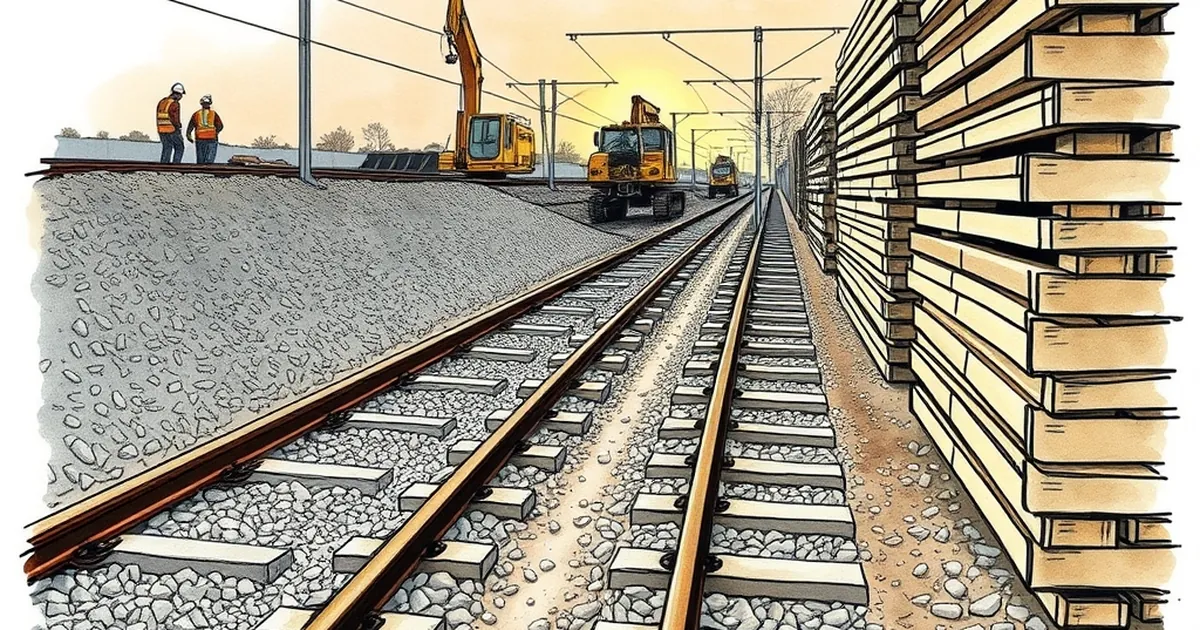
Anyone who has watched a track renewal crew at work knows the sequence looks almost choreographic: old rail out, old sleepers lifted, ballast scraped and replaced, new sleepers threaded in, rail welded back. So why does the ballast often show up on site days before a single sleeper has moved? It looks like a scheduling mistake, and on a bad day it is one — but more often it is a deliberate bet on how Polish construction logistics actually behave.
Why Ballast Arrives Before Anything Else Moves
Track renewal is a chain of dependencies, and ballast sits at the bottom of it. You cannot lay new sleepers on a formation that has not been cleaned, profiled, and topped up. You cannot run a tamping machine without a ballast bed to tamp into. And you cannot deliver ballast at the exact hour you need it, because the wagon that carries it has to come from somewhere, usually a quarry in a different voivodeship, on a network that is already congested.
That is the core logic. Pre-delivery is a buffer against the one thing track crews cannot control: the rail network's own traffic.
The Quarry-to-Site Distance Problem
Poland's ballast supply is concentrated in a handful of regions — dolomite and granite workings in the south, basalt in the southwest, with aggregate from Ślęża-area quarries feeding a good share of Lower Silesian and Opole projects. A renewal site near Olsztyn or Białystok is drawing material from several hundred kilometres away. Each train path has to be negotiated with PKP PLK, fitted around passenger services, and often runs at night.
When you are booking paths months in advance, you take what you can get. If the available slot is nine days before the sleeper swap, the ballast lands nine days early.
The Possession Window Is the Real Constraint
Renewal work happens inside track possessions — finite, expensive blocks of time when the line is closed. A possession of eight or twelve hours is not unusual for a weekend job. Within that window, the crew has to do everything: lift, scrape, lay, weld, tamp, test.
Every tonne of ballast that has to be brought in during the possession is time subtracted from the actual work. Pre-positioned stockpiles mean the dozers and the ballast trains are not competing for the same minutes. That single fact justifies a lot of early deliveries.
What Early Ballast Actually Costs
I have heard site engineers describe pre-delivered ballast as "free storage" — the material is on the ground, the wagons are gone, and nobody is paying demurrage. That is only half true, and the other half is where projects get into trouble.
Security, Weather, and Contamination
A ballast shoulder sitting beside a live track for a week is exposed. It collects fines, it can be picked up by wind, and in a wet autumn it drains poorly and cakes. More seriously, stockpiles near operational lines are a theft target — ballast disappears, and so do the geotextiles and fastenings stacked next to it.
There is also a maintenance-of-way angle. Material stored too close to the track can foul drainage or obstruct cable routes. On a recent Lower Silesian job I followed, the contractor ended up re-screening a portion of the pre-delivered stock because it had picked up clay during a rainy spell — a cost that never appeared in the delivery plan.
The Cash-Flow Squeeze Nobody Mentions
Ballast is heavy and cheap per tonne relative to its transport cost, which means invoices arrive early and in bulk. For a contractor working on a PKP PLK framework, paying for several thousand tonnes of aggregate weeks before the work it supports is billed is a genuine working-capital hit.
I have seen smaller subcontractors take delivery early simply because the quarry offered a discount for off-peak loading — a saving on paper that turned into a cash-flow problem two weeks later. The delivery was rational. The financing behind it was not.
How Good Polish Projects Sequence the Delivery
The projects that get this right treat ballast delivery as a scheduling instrument, not an afterthought. Three habits show up again and again.
Staging in Layers, Not in One Dump
Rather than one mountain of ballast, experienced site managers plan two or three smaller drops — a bottom layer for the formation, a top-up layer immediately before sleeper laying, and a final shoulder fill after tamping. This spreads the cash outflow, reduces contamination exposure, and keeps the stockpile within reach of the machines that need it.
It also matches how tamping actually works. The first pass after sleeper laying needs a bed that is already roughly profiled; the fine adjustment comes later. Delivering everything at once often means re-handling material you did not need yet.
Coordinating With the Possession Calendar
The best sequencing starts with the possession calendar, not the quarry order book. If the possession is a Saturday night, ballast should be on the ground by Thursday — early enough to absorb a cancelled path, late enough that it has not sat exposed for a fortnight.
That two-to-four-day window is the sweet spot most crews aim for, and it is worth arguing with the logistics planner about. A week early is usually too early; a day early is gambling.
A Concrete Example
On a section of the E30 line near Legnica, a renewal team I spoke with ran into exactly this. The ballast train was booked three weeks out because of a path conflict, so the material arrived long before the sleeper swap. Rather than leave it exposed, the crew arranged temporary sheeting and re-sequenced the drainage works to run first, using the stockpile area as a staging zone for the new sleepers as well.
It cost extra handling. It also meant that when the possession opened, the site was fully stocked and the tamping machine never waited. The engineer's verdict was blunt: "We paid for handling once. We would have paid for waiting every night."
The Takeaway for Anyone Planning Renewal Work
If you are scheduling a track renewal in Poland, treat the ballast delivery date as a negotiation, not a fixed point. Push for a window of two to four days before the possession, split the order into layers, and budget the working capital as carefully as you budget the tonnes. The material will almost certainly arrive before the sleepers move — the question is whether that early arrival is a plan or an accident.