November 2026
Commuters overpay 12 seconds to skip a 4-second walk
A short taxi ride at Warszawa Centralna reveals how commuters price their own time under stress, and why the math rarely works out in their favor
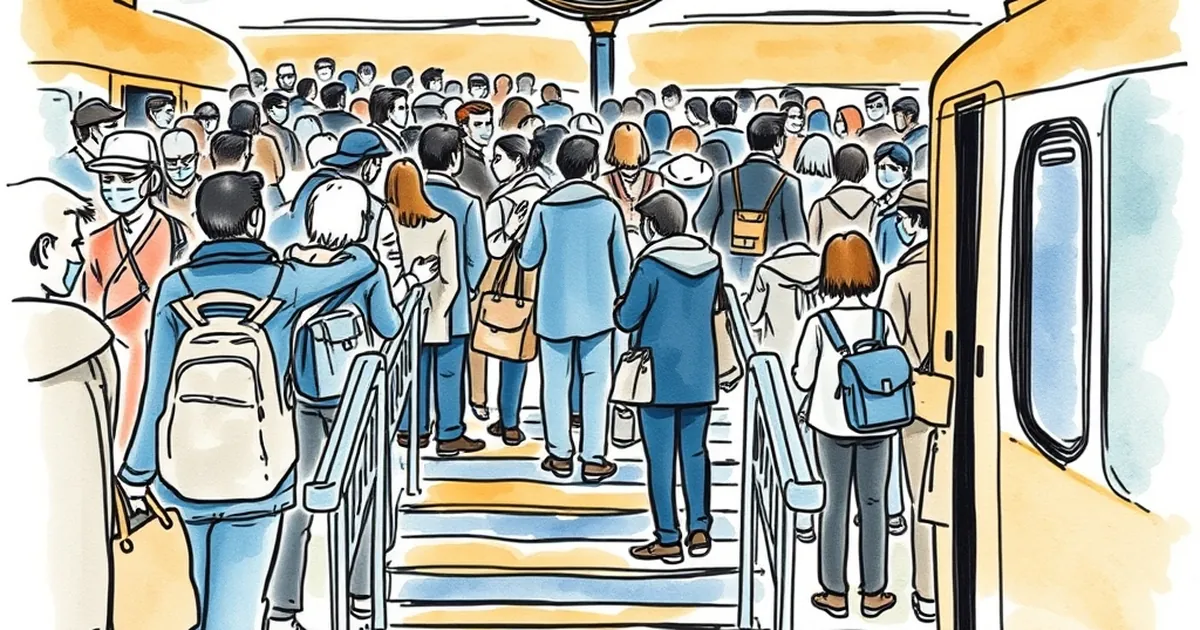
At Warszawa Centralna, the walk from the platform to the tram stop on Marszałkowska takes about four minutes. A taxi ordered through an app will cover the same distance in roughly one minute and forty seconds, assuming the lights cooperate. The passenger pays somewhere between 15 and 25 złotych for that saving, which works out to a spectacular implied hourly rate — and a small but telling case study in how people price their own time when a decision is made quickly, under mild stress, and with incomplete information. The question worth asking isn't whether the taxi is irrational. It's why the same person who comparison-shops for eleven minutes to save 40 groszy on coffee will spend twenty złoty to save three minutes on a walk they were going to take anyway.
The arithmetic nobody does at the curb
Behavioural economists have a name for the mental shortcut at work here: we don't evaluate a purchase in isolation, we evaluate it against a reference point. Daniel Kahneman and Amos Tversky's prospect theory established that losses loom larger than equivalent gains — roughly twice as large in most experimental settings. A commuter running late doesn't experience the taxi fare as a 20 złoty loss. They experience it as avoiding a 12-minute lateness, a missed connection, or the low-grade humiliation of arriving flushed and apologetic to a meeting. Framed that way, the fare isn't a price for transport. It's insurance against a small social loss, and people reliably overpay for that.
There's a second layer. The decision happens in a narrow window, often while walking, often on a phone, often with a train still audible in the background. Research on decision fatigue — and the broader literature on cognitive load — suggests that the quality of our trade-offs degrades as the day accumulates small choices. The commuter at 8:40 in the morning has already made dozens of micro-decisions before reaching the street. The taxi button is the path of least cognitive resistance, and the app is designed, deliberately, to be exactly that.
Variable rewards on the pavement
App-based transport has borrowed a page from a well-documented playbook. B.F. Skinner's work on variable-ratio reinforcement showed that behaviour rewarded on an unpredictable schedule is far more persistent than behaviour rewarded consistently. A pigeon pecking for a reward every time stops when the reward stops. A pigeon pecking for a reward on a random schedule keeps pecking long after the food is gone.
The modern ride-hailing app runs on this logic. Surge pricing, arrival estimates that shift by a minute or two, the occasional discount code that appears without warning, the driver who is "three minutes away" for nine minutes — none of it is fixed. The uncertainty is part of the product. It keeps the thumb hovering, and it makes the eventual fare feel like an outcome rather than a choice. Anyone who has watched a colleague refresh a journey estimate three times before committing has seen Skinner's pigeons on a phone screen.
Why the four-second walk feels longer than it is
Here's where the specific case gets interesting. The four-second walk — the stretch from the tram door to the pavement, or the crossing at a junction where the lights have just changed — is not really the thing being avoided. What's being avoided is the sequence: the wait, the crowd, the uncertainty about whether the tram is coming, the possibility of standing in drizzle for six minutes because a service is bunched. Commuters don't estimate the walk. They estimate the worst plausible version of the walk, and they pay to remove it.
This is an example of what psychologists call affective forecasting error: we systematically overestimate the emotional cost of future minor unpleasantries and underestimate our own capacity to absorb them. The drizzle is rarely as cold as anticipated. The six-minute wait is rarely six minutes. But the forecast is made in the moment, and the moment is what the fare is priced against.
There's a competitive dimension too, and it's not trivial in a city like Warsaw. Commuting is a low-stakes tournament. Arriving first, arriving dry, arriving with a seat on the tram — these are minor wins, but they're wins, and the research on competitive play suggests that people will accept poor expected value to secure a positional advantage over peers. The taxi isn't competing with the tram on price. It's competing with the version of you that got there late.
What infrastructure planners can actually take from this
The instinct among transport planners is to treat these choices as a pricing problem: make the tram fast and reliable enough and the taxi demand will fall. That's true at the margin, but it misses the psychological structure. The commuter isn't only buying speed. They're buying certainty, a clean seat, and the absence of a decision.
This is why the most effective interventions in Polish cities over the past decade have been less about raw journey time and more about legibility. Real-time departure boards at stops, which Warszawa has rolled out extensively, don't make trams faster. They make the wait feel shorter and, crucially, make the uncertainty disappear. A commuter who knows the tram arrives in four minutes is far less likely to summon a car than one who is staring at a blank pole. The information itself changes the calculation, because it removes the variable-ratio element that the app exploits.
Kraków's integrated transport app and the growing use of contactless payment on trams across Polish cities follow the same logic: reduce the friction of the good option, and the good option wins more often than the price differential would predict. Gdańsk's park-and-ride expansions work on a similar principle — not by making driving expensive, but by making the alternative feel predictable.
The forward-looking point is that the next decade of Polish transport investment will be judged less on kilometres of track and more on whether the system feels trustworthy at the moment of decision. That's an engineering problem and a behavioural one at the same time. A departure board that is right 95 percent of the time builds more loyalty than a tram that is fast 100 percent of the time, because the commuter's brain is running a forecast, not a stopwatch.
None of this means the taxi is a mistake. Sometimes the meeting matters, sometimes the rain is real, and sometimes twenty złoty is a fair price for arriving composed. But the gap between what commuters pay and what they save is a useful diagnostic. It tells us where the transport system is generating anxiety rather than removing it — and in a country investing as heavily in rail and urban transit as Poland is right now, that gap is worth measuring, station by station, before the next timetable is written.