October 2026
Concrete sleepers outlast the depots that store them
Poland's concrete sleepers can serve fifty years under traffic, yet the depots storing them keep closing, raising questions about railway asset life
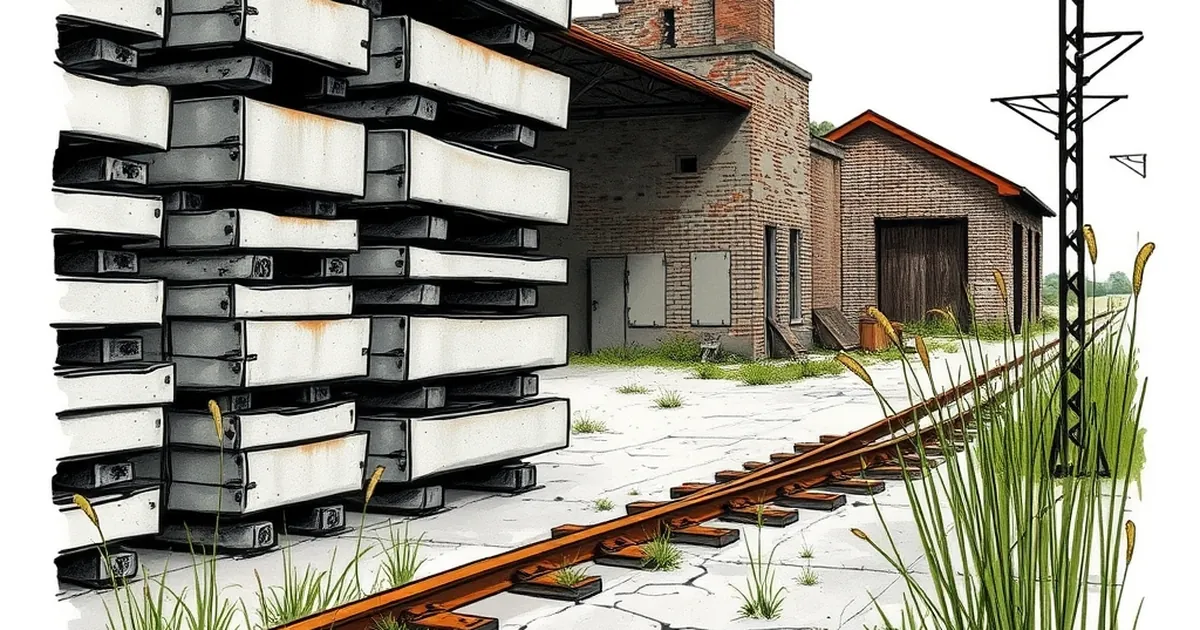
Poland's rail network runs on concrete sleepers. Tens of thousands of them sit in storage yards from Szczecin to Rzeszów, waiting for track renewal programmes that move slower than the material degrades. Here's the uncomfortable question: if a sleeper can serve fifty years under traffic, why do the depots holding them keep closing, relocating, or quietly disappearing from the books?
The Strange Arithmetic of Railway Asset Life
A prestressed concrete sleeper is one of the most durable objects in the entire transport system. Designed to BS EN 13230 standards, a modern monoblock sleeper can carry axle loads of 22.5 tonnes and more for decades, often surviving 40 to 50 years in mainline service before fatigue or cracking forces replacement.
Compare that lifespan with the infrastructure built to store it. A typical storage depot—often a leased plot with hardstanding, drainage, and a sidings connection—operates on commercial timescales measured in years, not generations. Lease terms end. Local zoning changes. A regional rail authority decides to consolidate its inventory elsewhere and the yard is sold for light industrial development within a single budget cycle.
The result is a peculiar asymmetry. The sleeper is the long-lived asset. The depot is the ephemeral one. And that mismatch has real consequences for how Poland plans its rail investments.
Why Concrete Wins on Paper and in the Ground
Concrete sleepers replaced timber across Polish railways largely because they resist rot, hold gauge under heavy loads, and don't need chemical treatment. PKP PLK's renewal programmes have leaned on them heavily, especially on lines upgraded under national and EU-funded modernisation schemes. Once installed, they need almost no attention beyond ballast maintenance and occasional fastening checks.
That durability is exactly what makes stockpiling them rational—and exactly what makes the depots that hold them look disposable by comparison.
What Happens When the Yard Closes
When a storage site shuts, the sleepers don't vanish. They get moved—sometimes hundreds of kilometres—to another facility. Every relocation adds handling costs, risks damage to prestressed units that don't tolerate rough crane work, and inserts logistics delays into renewal schedules.
I've seen the pattern described by track engineers across Central Europe: a depot closes to save on rent, the material migrates to a larger hub, and then a project in the original region needs sleepers urgently and pays a premium to truck them back. The savings from closing the yard evaporate in the first transport invoice.
There's a second, quieter cost. Depots are institutional memory. The staff who know which stacks hold the 2019 batch, which units failed a visual inspection, and which pallets are reserved for a specific bridge renewal—that knowledge walks out the gate when the site closes. Digital inventory systems help, but they rarely capture the same granularity.
A Concrete Example from the Regions
Consider the pattern in voivodeship-level rail projects. A local authority secures funding for a short-line upgrade, orders sleepers well in advance to lock in prices, and stores them at a regional depot. Two years later, the funding timeline slips. The depot's lease expires. The sleepers are consolidated into a national stockpile. When the project finally restarts, the material has to be re-sourced or re-transported, and the original cost advantage is gone.
It's not a dramatic failure. It's a slow leak of value that never appears on any single line item.
The Real Problem: Nobody Owns the Timeline
The core issue is organisational, not technical. Sleeper procurement sits with one team. Depot management sits with another. Lease decisions sit with a third. Project scheduling sits with a fourth. Each optimises its own horizon, and the sleeper's fifty-year life falls between the cracks.
Poland's rail investment pipeline has grown substantially, with Kolej Plus, the National Railway Programme, and continued EU cohesion funding driving demand for track components. That scale should make strategic stockpiling obvious. Yet storage capacity remains a low-priority line in most budgets—easy to cut when savings are needed.
What Better Practice Looks Like
Some operators have started treating sleeper stock as a strategic reserve rather than surplus inventory. That means:
- Longer lease horizons for depots, matched to multi-year renewal plans rather than annual budgets.
- Shared regional hubs serving several projects, with formal allocation rules so material isn't double-committed.
- Condition monitoring at storage, since concrete sleepers can suffer handling damage and stacking stress that only shows up years later.
- Joint planning between procurement and project scheduling, so orders track realistic installation dates.
None of this is exotic. It's basic asset management applied to an asset that happens to outlast the buildings around it.
The Forward-Looking Bet
The sleeper in the yard will probably still be serviceable when the depot that holds it is a car park. The question for Poland's rail planners is whether they design storage around that reality—or keep discovering, project after project, that the cheapest material is the material you didn't have to move twice.
The smart move is to stop treating depots as temporary. Give them the lease terms, the inventory discipline, and the strategic status their contents deserve. The concrete, after all, is already committed to the long game.