November 2026
Drivers brake 0.3 seconds later when a reward sign appears
Reward signs can delay driver braking by 0.3 seconds, adding four metres at 50 km/h and raising real questions about roadside design
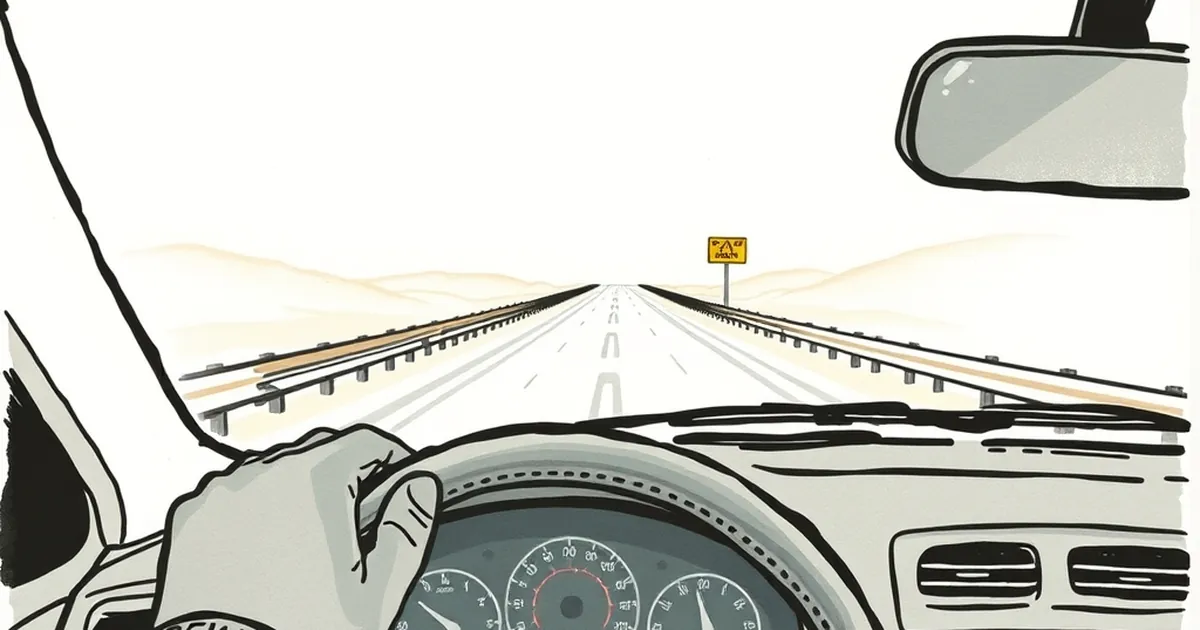
A roadside sign that promises a reward — points, a discount, a scratchcard-style token — can delay a driver's braking by roughly 0.3 seconds. At 50 km/h that is about four metres of extra travel, and four metres is often the difference between a near-miss and a police report. The question worth asking is not whether such signs work on people (they plainly do), but what a three-tenths-of-a-second shift in braking behaviour means for the way Polish cities, road authorities and private operators design the things they put beside the carriageway.
The number that should make road engineers uneasy
The 0.3-second figure comes from driving-simulator work on reward-associated roadside cues, and it lines up with a broader body of research on how anticipated rewards alter attention and motor timing. In a typical paradigm, participants drive a fixed route while roadside signage varies; when a sign is paired with a reward, braking onset at a subsequent hazard is measurably later than in the neutral condition. The effect is small in absolute terms and large in road-safety terms.
Do the arithmetic. Reaction time in the Highway Code and in Polish road-engineering practice is usually taken at around one second for an alert driver, with braking distance computed from there. A 0.3-second penalty at 50 km/h adds about 4.2 metres; at 70 km/h, roughly 5.8 metres. Pedestrian crossings in built-up areas are frequently designed with stopping-sight distances that leave far less margin than that.
This is not a fringe finding. It sits comfortably alongside what behavioural economists have documented for decades. Daniel Kahneman and Amos Tversky's work on loss aversion showed that people weigh losses more heavily than equivalent gains, which is precisely why reward framing is so potent: a sign that offers something to be gained recruits attention automatically, before deliberate control has a chance to intervene. The driver is not choosing to look; the attentional system has already made the choice.
Why a reward sign is not the same as a warning sign
Polish road signage is built on a warning logic. A-7 (pedestrian crossing), A-16 (slippery road), A-29 (traffic signals ahead) — these exist to raise arousal and prompt a specific anticipatory response. Their design vocabulary, red triangles and high-contrast pictograms, is deliberately aversive. It is meant to feel like a small alarm.
A reward sign inverts that. It is designed to be pleasant, to invite a glance, and to create a small pulse of anticipation. In reinforcement terms, this is a textbook variable-ratio schedule: the reward arrives unpredictably, which is exactly the schedule that produces the most persistent and most attention-hungry behaviour. B.F. Skinner's operant work established that unpredictable reward produces higher and more resistant response rates than predictable reward. Drivers who pass a sign that sometimes pays off and sometimes does not are being trained, subtly, to keep checking.
The road-safety consequence is a divided-attention tax that is invisible in the sign's own design brief. The operator measures impressions and redemptions; nobody measures the four metres.
The Polish context matters here
Poland has spent the last decade rebuilding its road network at a pace unmatched in the EU, and with it has imported a lot of roadside commercial inventory: fuel-station loyalty boards, retail park totems, app-download prompts on gantries near bypasses. The country also has one of the EU's more active debates about the safety of pedestrian crossings in built-up areas, particularly on multi-lane roads where a driver's glance away from the crossing is punished severely. Add a reward cue into that geometry and the margin for error narrows.
There is a further wrinkle specific to how Polish drivers learn. The category B syllabus and the egzamin praktyczny reward procedural correctness — mirror checks, signalling, observation at crossings. That training builds a deliberate, rule-following layer over the automatic attentional layer. Reward cues act on the automatic layer, which is the one that runs when a driver is tired, familiar with the route, or both. Commuter routes are exactly where reward signage concentrates, because that is where the traffic is.
Decision-making under uncertainty, at speed
The deeper issue is that a driver approaching a reward sign is making a decision under uncertainty, and doing so in about the time it takes to blink. Will the sign pay off? Is it worth a glance? The rational answer is almost always no — the expected value of a glance is a few złoty at best and a collision at worst. But humans are not expected-value calculators at 50 km/h. We are pattern-matchers running on compressed timescales, and we overweight small, vivid, near-term rewards relative to diffuse, distant risks.
This is the same cognitive architecture that makes near-misses feel like warnings rather than luck. In competitive settings — sport, trading, even amateur racing — the phenomenon is well documented: the closer the reward, the more the risk is discounted. Roadside reward signage borrows that architecture for commercial ends.
What the industry could do with this instead of ignoring it
The interesting question is not how to ban reward signage, which would be both impractical and probably counterproductive. It is how to design reward structures that recruit attention toward safety rather than away from it.
Some operators have already moved in this direction without naming the psychology. Fuel-station loyalty schemes that credit points for smooth, speed-limit-compliant driving — increasingly feasible with telematics in company fleets — flip the reinforcement schedule so the reward is contingent on the behaviour you want. Insurance telematics in Poland has grown steadily on exactly this logic. The variable-ratio engine is still there; it has simply been pointed at a different target.
The same principle applies to infrastructure. A crossing that gives a pedestrian a clear, early signal of being seen — a well-placed refuge, a raised table, a lighting scheme that reads at distance — is a reward cue for the driver, and a safety-positive one. Polish municipal road authorities experimenting with active crossings on voivodeship roads are, whether they frame it this way or not, running a behavioural intervention.
The measurement gap
The uncomfortable truth is that almost nobody measures the attentional cost of roadside commercial signage in Poland, and the same is largely true across the EU. Signage permits are granted on planning and aesthetic grounds; safety audits focus on sight lines and geometry. The 0.3-second figure is a laboratory result, not a field one, and the field version — with real weather, real fatigue, real traffic — could be larger or smaller.
That gap is an opportunity. A modest field study, using instrumented vehicles on a handful of Polish commuter corridors with and without reward signage, would produce something genuinely useful and, as far as the published literature goes, relatively novel. The methodology exists; the will to fund it is the missing piece. Road authorities in a country that has just spent billions on infrastructure should want to know whether the furniture beside it is quietly eroding the safety margin they paid for.
Until then, the practical takeaway for anyone specifying roadside inventory is simple: treat a reward cue as a hazard-adjacent object, not as decoration. Place it where a glance costs nothing — before a junction, not at the approach to a crossing; on a straight, not on a curve. And when a scheme's designers propose a variable, unpredictable payout, ask what behaviour the schedule is actually reinforcing, and over what distance.
The three-tenths of a second is real. The question is who owns it.