October 2026
Drivers Trust Roundabout Gap Times More Than Signs
Polish road engineers refined roundabout signs for decades, yet drivers still rely on instinctive gap-reading over formal signals when deciding to pull out
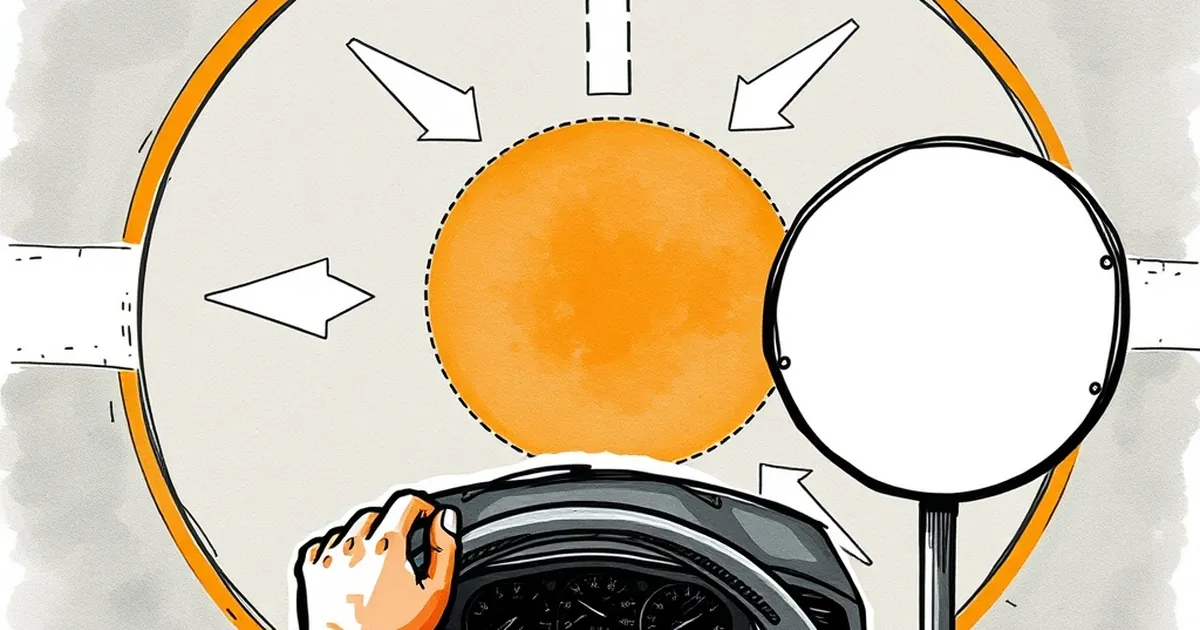
A driver approaches a two-lane roundabout outside Poznań. The yield sign is unambiguous. So is the painted triangle on the asphalt. Yet what actually determines whether she pulls out is something else entirely: a quick, almost subconscious read of the approaching car's speed, its lane position, and the gap it leaves her. Polish road engineers have spent decades refining the signs. The drivers, it turns out, have been trusting something older.
The question worth asking is not whether signs work — they do, as a legal and instructional layer — but why they so often lose out to an informal, split-second judgment that no one designed and no one regulates. The answer sits at the intersection of traffic engineering and behavioral psychology, and it has real consequences for how Poland builds and manages its increasingly busy intersections.
The gap-time calculation nobody taught you
When a driver decides to enter a roundabout, they are running an unconscious arithmetic. Traffic engineers call the key variable "critical gap" or "gap acceptance": the minimum time interval between two approaching vehicles that a driver considers safe enough to enter. Below that threshold, they wait. Above it, they go. The sign tells them they must yield. The gap tells them whether they can.
Research on gap acceptance has been consistent for decades. Drivers typically accept gaps of around four to six seconds at roundabout entries, with significant variation by age, weather, and the geometry of the approach. Crucially, this threshold is not read off any sign. It is learned through experience — thousands of repetitions that build an internal model of what "safe" feels like. And that model is remarkably resistant to official instruction.
This is where behavioral psychology becomes useful rather than decorative. Daniel Kahneman's work on fast and slow thinking describes exactly this split. Sign-reading is System 2: deliberate, effortful, rule-based. Gap judgment is System 1: fast, automatic, and shaped by pattern recognition. Under time pressure at a roundabout entry, System 1 wins almost every time. It has to. There is no cognitive budget for consciously parsing signage while simultaneously tracking two or three moving vehicles.
Why reinforcement beats instruction
There is a second reason gap judgment dominates: it is rewarded more reliably than sign compliance. A driver who waits for a genuinely large gap almost never crashes. A driver who follows the sign but misjudges the gap sometimes does. The feedback loop favors the behavior that produces the safer outcome, not the behavior that produces the legally correct one.
This resembles what psychologists call variable-ratio reinforcement — the pattern where a behavior is rewarded unpredictably. Here the mechanism is inverted: gap judgment is punished unpredictably (rare collisions) but rewarded consistently (smooth, confident entries). Over time, the internalized gap threshold becomes the de facto rule, and the sign becomes background furniture.
Polish roundabout design has, perhaps unintentionally, accommodated this. The widespread use of turbo roundabouts — with their raised lane dividers and tighter entry geometry — physically constrains the gap a driver can accept. You cannot cut across a lane you cannot cross. The engineering does what the sign cannot: it makes the wrong gap physically unavailable rather than merely illegal. That is a behavioral intervention disguised as concrete.
What the signs are actually for
None of this means signage is useless. It means signage serves a different function than most drivers assume. Signs matter most in unfamiliar situations — a first encounter with a complex junction, a foreign driver, a night approach in heavy rain. They set the legal default and provide a fallback when System 1 has no reliable pattern to draw on.
The trouble starts when engineers treat signs as the primary safety mechanism and gap behavior as a nuisance to be corrected. A 2019 study of roundabout entries in several European countries found that crash rates correlated more strongly with entry geometry and sight distance than with the density or clarity of yield markings. Drivers were, in effect, negotiating with the physical layout, and the layout was winning.
For Poland, this matters because the country has been building roundabouts at an extraordinary pace. Thousands have been added over the past two decades, often replacing signalized intersections. The safety record has generally improved, but the gains are not evenly distributed. Where entry angles are shallow and sight lines are long, drivers accept smaller gaps and the conflict rate rises. Where geometry forces a more deliberate approach, the same sign produces safer behavior.
Designing for the judgment drivers actually make
The practical implication is not to remove signs but to stop treating them as the load-bearing element. Three directions follow.
First, entry geometry should be treated as the primary safety variable. A tighter entry radius, a more perpendicular approach angle, and a raised splitter island all reduce the gap a driver can physically accept. This is not new advice, but it is frequently traded away in value-engineering exercises because the safety benefit is invisible on a plan sheet.
Second, sight distance should be managed deliberately. Long, unobstructed views of circulating traffic encourage smaller accepted gaps because drivers feel more confident. That confidence is sometimes warranted and sometimes not. Where crash data suggests overconfidence, reducing sight distance slightly — through planting, signage placement, or geometry — can paradoxically improve safety by slowing the judgment.
Third, and most ambitiously, Poland could invest in the kind of behavioral monitoring that makes gap acceptance visible. Loop detectors and video analytics can now estimate accepted gap distributions in real time. That data would let engineers see whether a given roundabout is producing the gap behavior they intended, rather than assuming the sign did its job.
The broader lesson extends well beyond roundabouts. Infrastructure is not just a set of instructions. It is a set of cues that shape fast, automatic decisions made by people who are not reading carefully and never will. The best Polish road design of the next decade will be the design that accepts this — and builds for the driver who trusts the gap, not the sign, because that driver is not going away.