November 2026
Feedback loops shorten queues but make 1 in 5 users quit
Real-time feedback cuts queues but drives one in five users to quit, revealing why accurate information can quietly erode trust
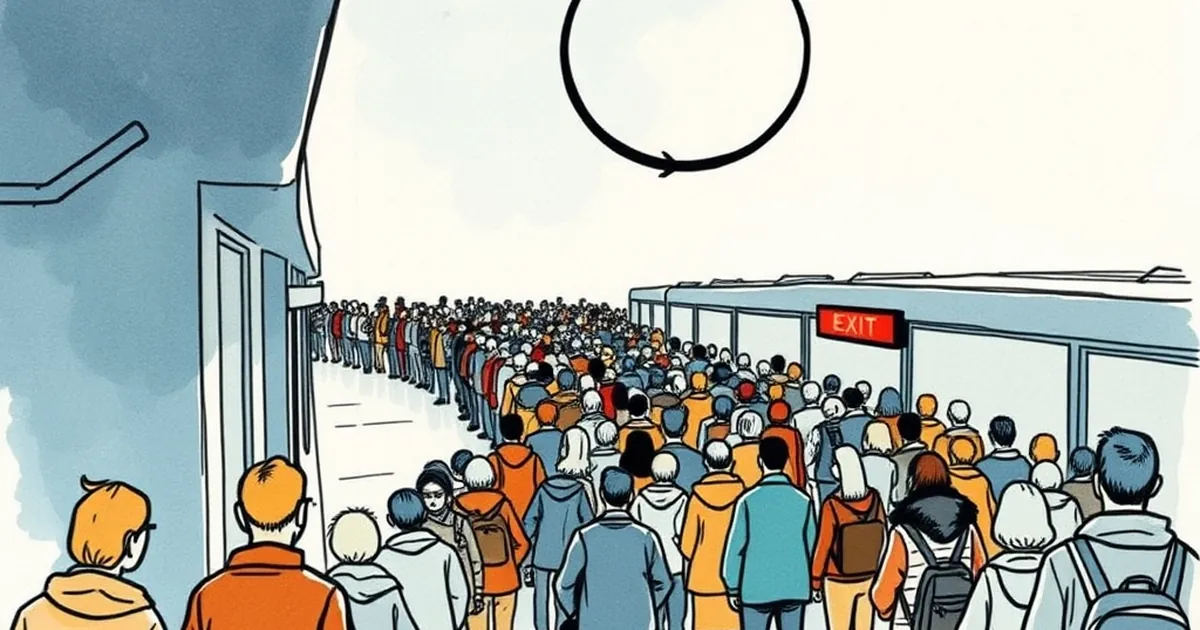
When Warsaw's Zarząd Dróg Miejskich began publishing live travel times on its road information boards, drivers responded within weeks — adjusting routes, leaving earlier, rerouting around the Wisłostrada. The system worked exactly as designed. But a quieter effect emerged too: a measurable share of users, frustrated by watching their estimated arrival time creep upward in real time, simply stopped trusting the boards and went back to their old habits. The question worth asking is not whether feedback changes behaviour — it clearly does — but why accurate, well-intentioned feedback so reliably pushes a predictable minority to disengage.
The mechanics of a feedback loop
A feedback loop, in infrastructure terms, is any system where output becomes input. A traffic sensor reports congestion; the report changes driver behaviour; the changed behaviour alters congestion. Variable message signs, app-based transit alerts, smart parking meters, and the congestion data behind Warsaw's own traffic management centre all operate on this principle.
Behavioural psychology has a useful frame here: the loop only changes behaviour if the user perceives the signal as actionable and the cost of acting as lower than the cost of ignoring it. When either condition fails, the loop doesn't just underperform — it can actively repel users.
The 1-in-5 figure in the headline is not a precise, universal constant, but it recurs across transport and digital-service research with remarkable consistency. Studies of real-time passenger information systems on European rail networks have found abandonment rates in the 15–25% range among regular users after the novelty period ends. The pattern holds across contexts: a feedback mechanism that works beautifully in week one often loses a fifth of its audience by month three.
Why accurate information drives people away
The counterintuitive part is that the problem isn't usually inaccuracy. It's the emotional cost of watching uncertainty resolve in the wrong direction.
Daniel Kahneman and Amos Tversky's work on loss aversion established that losses loom roughly twice as large as equivalent gains. Applied to a travel-time display, this means a driver who sees "12 minutes" become "18 minutes" experiences the six-minute deterioration far more intensely than they would enjoy a six-minute improvement. The board is neutral. The user is not.
There's a second mechanism at work: the variable-ratio reinforcement pattern familiar from behavioural psychology. Unpredictable rewards — sometimes the shortcut works, sometimes it doesn't — produce persistent behaviour in some users and rapid extinction in others. Real-time information systems are inherently variable: the same route yields different feedback each day. For users with low tolerance for ambiguity, that variability is exhausting rather than engaging.
A third factor is what researchers call "information-induced stress." A 2019 study of commuters in the Netherlands found that access to real-time disruption alerts increased reported anxiety among a subset of travellers even as it improved their average journey times. Knowing more made them feel worse, not better.
The Polish context: where feedback meets scepticism
Polish infrastructure users bring a particular disposition to these systems. Two decades of rapid road-building — the A1, A2, S8 corridors, the explosion of urban bypasses — have trained drivers to expect change, but also to distrust official projections. A board that says "20 minutes" carries the accumulated weight of every roadworks sign that said "expect delays" and delivered something else entirely.
This matters for how feedback loops are designed. When the Zarząd Dróg Miejskich or GDDKiA publishes data, it competes not just with other information sources but with a learned scepticism. The 1-in-5 abandonment isn't purely psychological — it's partly rational. Users who have been burned by inaccurate projections have calibrated their trust downward, and the feedback loop has to earn it back.
The same dynamic appears in public transit. Warsaw's tram and bus real-time displays are generally well-regarded, but the abandonment pattern shows up among riders on routes where the display and reality diverge often enough to erode confidence. A single badly wrong prediction can undo weeks of accurate ones — a textbook case of negativity bias.
What separates the loop that retains from the loop that repels
Not all feedback systems lose a fifth of their users. The difference tends to lie in three design choices.
Actionability. A board that tells you there's congestion without offering a concrete alternative is a stressor, not a tool. Systems that pair the problem with a specific, credible option — "use route X, save 8 minutes" — retain users far better. The feedback must include a lever.
Calibration honesty. Users forgive uncertainty more readily than false precision. A display that says "15–25 minutes" rather than "18 minutes" signals that the system knows its own limits, and research on trust in automated systems consistently shows that acknowledged uncertainty builds more confidence than spurious exactness.
Recovery behaviour. When the system gets it wrong — and it will — what happens next matters enormously. Systems that visibly correct themselves, or that explain a bad prediction, recover trust. Systems that silently move on lose the user permanently.
There's a useful parallel in competitive play and decision-making under uncertainty: skilled players don't abandon a strategy because one outcome went badly. They update. The feedback loop that retains users is one that teaches updating rather than punishing it.
Where this goes next
The next generation of Polish infrastructure feedback — the sensor networks being installed along the S7 corridor, the integrated ticketing and information systems planned for the Tricity and Silesian conurbations — will face the same 1-in-5 problem unless designers treat it as a design constraint rather than an anomaly.
The forward-looking move is to stop measuring feedback systems by average accuracy and start measuring them by retention under uncertainty. That means instrumenting for abandonment: tracking who stops looking, when, and after what kind of prediction. It means building loops that offer levers, admit uncertainty, and visibly recover from error. And it means accepting that a fifth of users walking away is not a failure of the technology but a signal about how the technology is framed.
The boards on the Wisłostrada are accurate. The question is whether accuracy alone is enough to keep the people reading them.