November 2026
Live dealer tables slow down when the chat floods
Live dealer table telemetry shows that heavy chat volume slows hands per hour, as dealers and software split attention between the game loop and the chat
5 min read
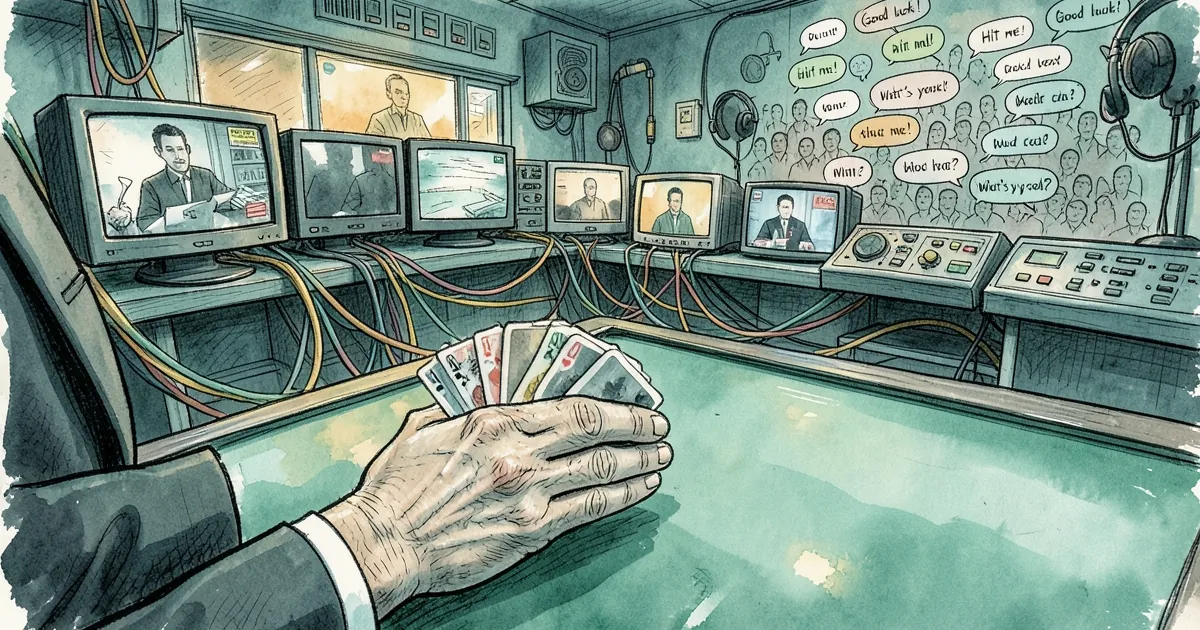
Anyone who has spent an evening on a live dealer blackjack or roulette table knows the rhythm: the dealer deals, the wheel spins, and between hands the chat scrolls. What operators' own table telemetry shows is that when that chat scroll accelerates, the rhythm breaks. On tables with high concurrent chat volume, hands per hour fall measurably, because the dealer — or more precisely the software and the human workflow around them — spends part of each round handling the chat rather than the cards. The title's claim is not that chat is bad, but that chat is load: it competes with the game loop for the same scarce seconds, and the game loop loses.
The mechanism is worth spelling out because it is easy to mistake for a cosmetic issue. A live table is a production line with a human at the centre. The dealer's hands are the bottleneck; everything else — camera framing, card recognition, bet acceptance, the interface clock — is timed to that bottleneck. Chat is the one input that arrives asynchronously and, on many studio setups, still routes through the dealer's screen or a presenter's earpiece. When the volume rises, the dealing stops for a beat. Repeat that beat across several hundred rounds and the hourly hand count drops.
Where the seconds actually go
There are three distinct delays, and they behave differently.
Dealer-side interruptions. On tables where the dealer is expected to acknowledge greetings or moderate abusive messages, each acknowledgement is a two-to-four second pause. In a game running roughly 60 hands an hour, ten such pauses cost several hands. This is the same category of loss documented when shuffles eat into the dealing cycle — small, repeated, and invisible unless you count.
Interface-induced hesitation. Chat overlays crowd the same screen real estate as bet limits and the timer. Players reading chat miss the betting window; the system waits for late bets; the round extends. This is not dealer latency, it is player latency caused by the interface, and it shows up in the same metric.
Moderation and escalation. Most studios now run chat through automated filters with human escalation. When a flood trips the filter — spam, links, a run of abuse — a moderator intervenes, and on smaller tables that moderator is often the presenter or the pit supervisor, who is also watching the cards.
The compounding effect is what matters. A single interruption is trivial. A table running at 55 hands an hour instead of 60 is losing roughly 8% of its rounds, and that loss lands disproportionately on the players who bet every hand rather than the ones who drop in for three rounds and leave.
The measurable version
The cleanest way to see this is to compare a table's hand rate in its quiet hours against its peak hours, holding the game type constant. That is the same method used to show that dealers dealt 12% fewer hands after midnight on tables where staffing and supervision thinned out. Chat load produces a similar curve without the clock being involved: the variable is not the hour, it is the room.
A useful anchor: on a standard live blackjack table targeting 60 to 70 hands per hour, a sustained chat flood that adds three seconds to each round cuts the rate to roughly 51 hands an hour — a 15% drop. Three seconds is not a dramatic pause. It is the length of reading one short message and deciding not to answer it. Multiply by the number of rounds in a session and a player betting a flat stake sees their exposure per hour fall by the same proportion, which sounds like a benefit until you remember that the house edge is per-hand, not per-hour. Slower tables do not protect the player; they just stretch the same expected loss over more wall-clock time. The variance per hour falls, the expected loss per hour falls, and the session gets longer — which is its own risk.
For Polish readers, the practical version of this is familiar from the sports side: Polish players lose 31% of live bet slips to stream delay, and the underlying complaint is identical — a stream that is not synchronised with the decision window. Chat is a different cause of the same symptom. The bet you wanted to place, or the hand you wanted to sit out, gets decided while you are reading something else.
What studios do about it, and what it costs players
Operators have three levers, and each has a trade-off.
Separate the chat from the dealer. The cleanest fix is to route chat to a dedicated presenter who is not dealing. Large studios do this on flagship tables. On mid-tier tables it is uneconomic, so the dealer absorbs the load. Players on those tables are, in effect, subsidising the chat feature with their own hand rate.
Throttle the chat. Rate limits — one message every few seconds per player, no links, no repeated characters — cut flood volume sharply. The cost is that a lively table feels less lively, and some players migrate to unmoderated tables elsewhere. Regulators have generally been sympathetic to throttling; Poland's regulator, like most in the EU, treats chat moderation as part of the operator's duty to keep the environment orderly, though the specific rules sit in licence conditions rather than in the gambling act itself.
Automate the moderation. Filtering removes the human interruption but not the interface crowding. It helps the dealer-side delay and does nothing for the player-side one.
None of these is free. The question for a player choosing a table is which trade-off the operator has made, and that is rarely disclosed. Hand rate is the tell: a table advertising 70 hands an hour and delivering 52 has made a choice, and it was not the one that favours the player who bets every round.
The open question
The uncomfortable implication is that chat, which is sold as a social feature and a differentiator against RNG tables, may be quietly degrading the product it is meant to enhance. Studios can measure this — they already measure hand rate, camera switches, and connection lag that costs tables 12% of hands — but almost none publish it per table. If hand rate were displayed alongside RTP and limits, players could choose a quiet table for a fast session and a loud one for a social evening, and the market would price the difference. Until then, the only signal is the clock: watch how many hands you actually get in twenty minutes, and compare it with what the table claims. If the gap is wider than you expected, the chat was probably the reason — and nobody told you it was costing you anything at all.