October 2026
Polish rail sidings outlive the freight they once served
Poland’s forgotten rail sidings still curve toward dead factories and empty coal yards, raising questions about why a vast unused network endures
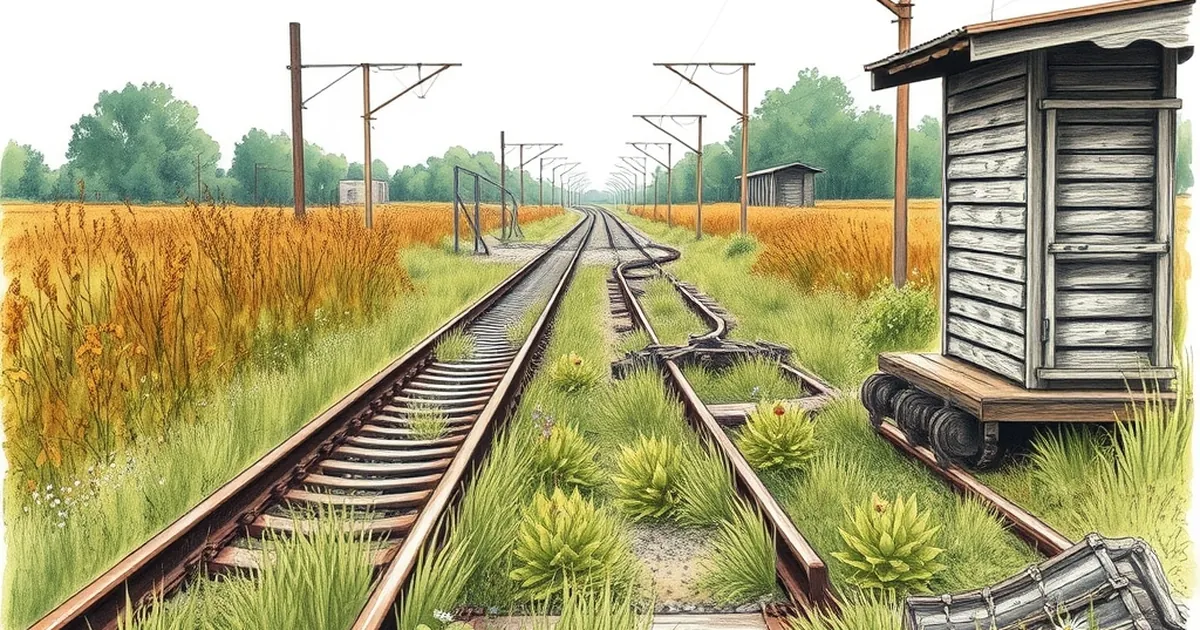
Drive east out of almost any Polish town of more than a few thousand people and sooner or later you will cross a set of rails curving away from the main line toward a crumbling loading ramp, a brick warehouse with broken windows, or a patch of nettles where a coal tip used to be. The tracks are still there, the sleepers are still there, and often a faded sign still names the plant that paid for them. So why does Poland keep a network of railway sidings that in many cases have not seen a wagon in fifteen years?
The scale of the thing nobody counts
Nobody really knows how many sidings Poland has. The official registers are a mess: some are listed as part of the national network managed by PKP Polskie Linie Kolejowe, some belong to private companies, some to municipalities, and a large number sit in a legal grey zone where the owner died, the company was liquidated, or the land was quietly sold to a developer who is waiting for the zoning plan to change.
Rough estimates put the total at somewhere between 2,000 and 3,000 sidings, of which perhaps a third still handle regular traffic. The rest are what the industry calls "inactive" — a polite word for rusting.
The reason the count matters is money. Every level crossing over a siding needs maintenance. Every kilometre of track needs drainage, vegetation control and, at minimum, an annual inspection. A dead siding is not free; it is a small, permanent tax on whoever owns it.
Why they were built, and why they stopped paying
The Polish People's Republic built its industrial geography around rail. A factory was sited next to a line, a siding was laid to the gate, and the plant received coal, coke, sand, timber or scrap by the wagonload. This was not sentimentality — it was the only sensible logistics model when the road network was thin and lorries were scarce.
The 1990s broke that model quickly. Small and medium plants went under or were bought and restructured. Coal deliveries shifted to road as collieries closed and customers got smaller. A single wagon of coal became a delivery of three tonnes by tipper truck, and the tipper truck could reach the boiler house without a shunting crew, a brake test and a locomotive hire fee.
By the time Poland joined the EU in 2004, the economics had flipped decisively. Rail freight works when you move trainloads over distance. A siding serving a plant that ships two wagons a week is a museum piece.
The privatisation wrinkle
There is a specific Polish twist here. When the state railways were split up and the freight operator PKP Cargo was separated from the infrastructure manager, the sidings attached to industrial plants often stayed with the plant — but the plant had usually been privatised by then, sometimes to foreign owners who had no idea they had inherited a rail connection.
I have spoken to plant managers who discovered their siding only when a tree fell across it and the insurer asked who was responsible. That is not an exaggeration; it is a recurring administrative surprise in medium-sized Polish towns.
The siding that refused to die
Consider the case of a sugar factory in the Kujawy region — one of the survivors of the great consolidation of the Polish sugar industry in the 2000s, when a dozen plants closed and a handful absorbed their quotas. The plant kept its siding because sugar beet is heavy, seasonal and moves in volume. Every autumn, during the campaign, the siding earns its keep: hundreds of wagons of beet arrive, and the plant ships out bulk sugar.
For the other ten months of the year, the siding sits idle. The plant keeps it because the cost of maintaining a dormant connection is far lower than the cost of rebuilding one. Rip up the track and the land reverts to something else; rebuild it and you are dealing with environmental permits, a new connection agreement and a queue at the infrastructure manager.
That calculus — cheap to keep, expensive to replace — explains a great deal of the Polish siding stock. It is not nostalgia. It is an option premium.
What is actually happening to the dead ones
Three things, broadly.
Reactivation
A minority are coming back. The boom in container terminals, the growth of inland ports along the Oder and Vistula, and the push to shift freight off roads have made some sidings valuable again. Logistics developers building warehouses near junctions are increasingly willing to pay for a rail connection, because a tenant who can receive containers by train is a tenant who will stay.
The catch is that reactivation is slow and bureaucratic. The technical standards for a connection are strict, the safety case is demanding, and the process can take years.
Repurposing
Some sidings are finding new lives as something other than freight infrastructure. The most visible example is the growing fashion for turning disused rail corridors into cycle paths — the so-called "velostrady" and local greenways. Not every siding qualifies, but where the alignment is straight and the land is publicly owned, a dead spur can become a genuinely useful piece of local transport.
There is also a quiet market in siding land for light industry and warehousing, especially where the track can be lifted without a fight over ownership.
Slow decay
Most, however, are simply decaying. Vegetation takes over, drainage fails, rails corrode, and the legal status becomes more tangled with each passing year. A siding that is merely unused today can become effectively unrecoverable in a decade, because the cost of restoring it exceeds any plausible freight revenue.
The uncomfortable question about who pays
Here is where the Polish debate gets sharp. If a siding is privately owned and unused, the owner pays — in theory. In practice, many owners are municipalities, state agencies or companies in liquidation, and the maintenance simply does not happen.
That creates a safety question. A siding that crosses a public road at a level crossing is still a level crossing, even if nothing has run over it since 2011. The signage, the sightlines and the road surface all still matter to the driver of a car at seven in the morning.
There is also a planning question. A dead siding occupies land in the middle of towns that could be housing, a school or a road. Keeping it "just in case" has a real opportunity cost that rarely appears in any budget document.
What to watch next
The most useful thing Poland could do is the least glamorous: build a proper, public, maintained register of sidings, with ownership, technical condition and traffic status. Without it, every discussion about reactivation, repurposing or closure starts from anecdote.
For anyone with a stake in this — a plant manager, a local councillor, a developer eyeing a plot — the practical move is to find out what is actually on the ground before the next zoning plan is adopted. Walk the siding. Check the land register. Ask the infrastructure manager whether the connection agreement is still alive.
The rails will outlast a lot of things. Whether they outlast the reason they were laid is a decision Poland has not yet made, and the clock is running.