November 2026
Skill tests beat coin flips on 2 of 3 bridge inspections
Two inspection crews, one bridge, opposite findings: why converting ambiguous signals into decisions shapes Poland's bridge inspection outcomes
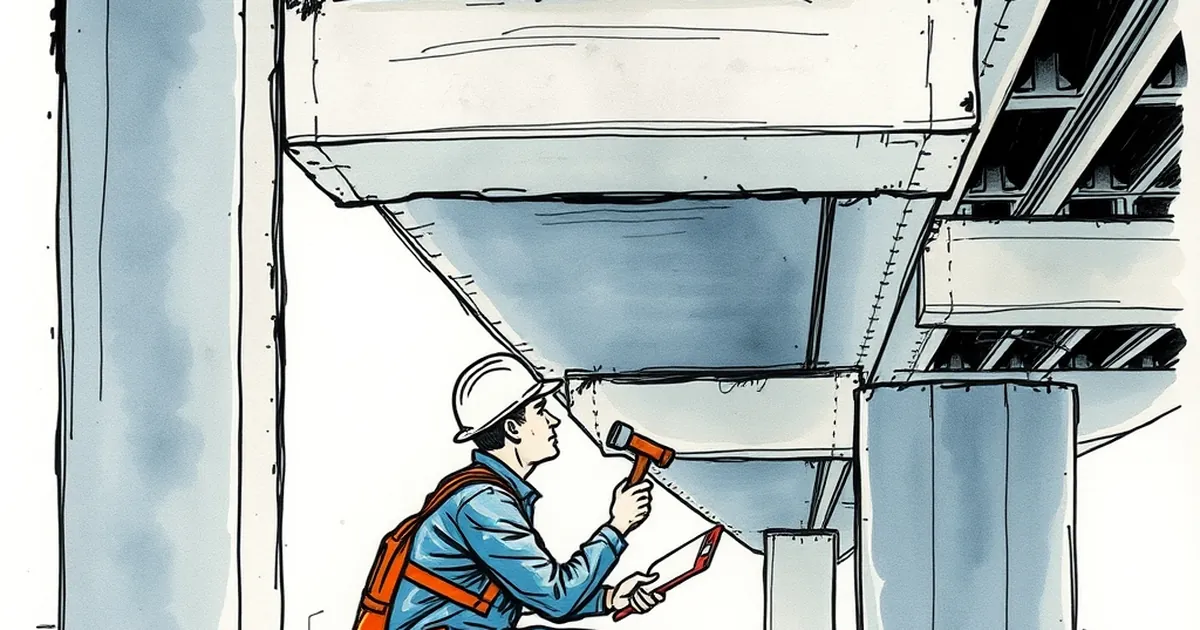
Two inspection crews, same bridge, same checklist, same weather. One finds the scour problem under pier three; the other signs off and moves to the next span. The difference is rarely diligence or eyesight. It is how each crew converts ambiguous signals — a stain, a faint crack, a slightly soft patch of riverbed — into a decision under uncertainty. That gap is a behavioural problem as much as an engineering one, and it is where Poland's bridge inspection regime deserves closer scrutiny than it usually gets.
The Inspection Is a Decision, Not a Measurement
A routine bridge inspection feels like data collection. In practice it is a sequence of judgements: is this crack width within tolerance, is that discolouration active corrosion or old staining, does the deck deflection warrant a detailed assessment. Each judgement is a small bet placed with incomplete information.
Kahneman and Tversky's work on loss aversion explains a persistent pattern here. Inspectors who flag a defect that later proves minor may face questions about over-reporting; inspectors who miss a defect that later matters face far worse consequences — but only if the miss surfaces. The asymmetry in immediate feedback pushes cautious professionals toward under-flagging, even when the long-run risk runs the other way. This is not cynicism about inspectors. It is a predictable response to how institutions reward and punish.
The practical implication is that two inspections of the same structure are not two measurements of the same quantity. They are two decision processes, and they can diverge even when both are conducted competently.
Variable Rewards and the Attention Problem
Routine inspection is repetitive by design. Most spans are fine. Most visits produce routine findings. That pattern is exactly the condition under which attention dulls.
Behavioural research on variable-ratio reinforcement — the schedule in which a reward arrives after an unpredictable number of responses — shows it produces unusually persistent engagement. The flip side is that predictable absence of reward produces disengagement. An inspector who has walked forty uneventful spans is being trained, quietly, to expect the forty-first to be uneventful too.
Aviation and rail have addressed this directly through mandatory reporting cultures and non-punitive near-miss systems. Bridge inspection in Poland has moved in that direction with the requirement for periodic detailed inspections under the road law, but the feedback loop remains slow. A defect found today may not be confirmed as significant for years. Slow feedback is weak feedback.
Skill Tests Beat Coin Flips — And the Data Says So
The framing of "skill tests versus coin flips" is not rhetorical. It maps onto a real question in inspection quality assurance: when two inspectors disagree, is the disagreement noise, or does it reflect genuine differences in skill that can be identified and improved?
A useful reference point is the work on inter-rater reliability in visual inspection, well documented in structural health monitoring literature and in the UK's bridge assessment programmes. When inspectors are asked to grade the same defects independently, agreement on obvious defects is high — typically above 80% for clear structural cracking. Agreement on marginal defects collapses, sometimes to barely better than chance. The interesting result is what happens next: when inspectors are given calibrated reference images and structured decision trees, agreement on marginal cases improves substantially. The skill is trainable, and the training is cheap relative to the cost of a missed scour event.
This is the empirical basis for saying skill beats a coin flip. The coin flip is what you get when you put an uncalibrated inspector in front of an ambiguous signal. The skill test is what you get when the same inspector has a reference set, a decision rule, and a culture that treats flagging as competence rather than alarmism.
Poland's General Directorate for National Roads and Motorways (GDDKiA) manages a large bridge stock with a substantial share of structures past their design life. The inspection workforce is experienced but unevenly calibrated across regions and contractors. A structured calibration programme — shared reference imagery, periodic blind re-inspection of sample spans, and comparison of results — would cost a fraction of a single emergency repair and would convert an unknown quantity into a measurable one.
Competitive Play as a Calibration Tool
There is a counterintuitive lever here: competition. Not between inspectors in a punitive sense, but in the sense that competitive environments with clear scoring produce sharper judgement than cooperative ones without it.
This is well established in decision science. When people know their judgements will be compared against a reference standard and against peers, they invest more cognitive effort and rely less on gut feel. The effect is strongest for exactly the marginal cases where inspection quality matters most. Bridge inspection has traditionally avoided this, treating comparison as a threat to professional autonomy.
A more productive framing is the one used in competitive technical fields: the score is not a judgement of the person, it is a measurement of the process. A regional calibration exercise in which inspection teams independently assess a set of reference spans, with results shared and discussed, is competitive play in the useful sense. It surfaces where judgement diverges and why, without requiring anyone to defend a past decision.
Risk-Taking Under Uncertainty Is the Real Subject
The deepest issue is that inspection decisions are risk decisions, and humans are bad at risk under uncertainty in specific, predictable ways. We overweight vivid, recent events — a collapse somewhere in Europe sharpens attention for a season — and underweight slow, cumulative processes like chloride ingress or scour that produce no dramatic signal until they do.
Kahneman's distinction between the experiencing and remembering self is relevant in an unexpected way. An inspector remembers the dramatic finds and the uneventful visits; the slow accumulation of marginal calls that were probably right is not memorable. That asymmetry means the distribution of judgement quality is invisible to the people making the judgements.
The fix is structural, not motivational. Record marginal calls. Compare them against later detailed assessments. Feed the results back on a timescale short enough to matter. Make the invisible distribution visible.
What Forward Looks Like
The next step for Polish bridge management is not more inspections. It is better measurement of the inspection itself. Three concrete moves are available now.
First, build a shared reference library of marginal defects — scour, fatigue cracking, bearing deterioration — with agreed grading. This is a calibration tool, not a training course, and it should be updated as structures age.
Second, run periodic blind re-inspections on a sample of spans, with results compared across teams and regions. Treat divergence as information about the process, not about individuals.
Third, shorten the feedback loop. Where a marginal call is made, track it to the next detailed assessment and report back. The goal is to convert a slow, invisible learning environment into a fast, visible one.
None of this requires new legislation. It requires treating the inspector's judgement as the critical instrument it is, and calibrating it the way any critical instrument is calibrated — against a known standard, repeatedly, with the results recorded. The bridge does not care whether the inspection was a skill test or a coin flip. The people who use it should.