September 2026
The 96% RTP Trap: Why Slot Payback Percentages Mislead Polish Players
A 96% RTP is a long-run average across millions of spins, not a session outcome, and that gap misleads many Polish online casino players
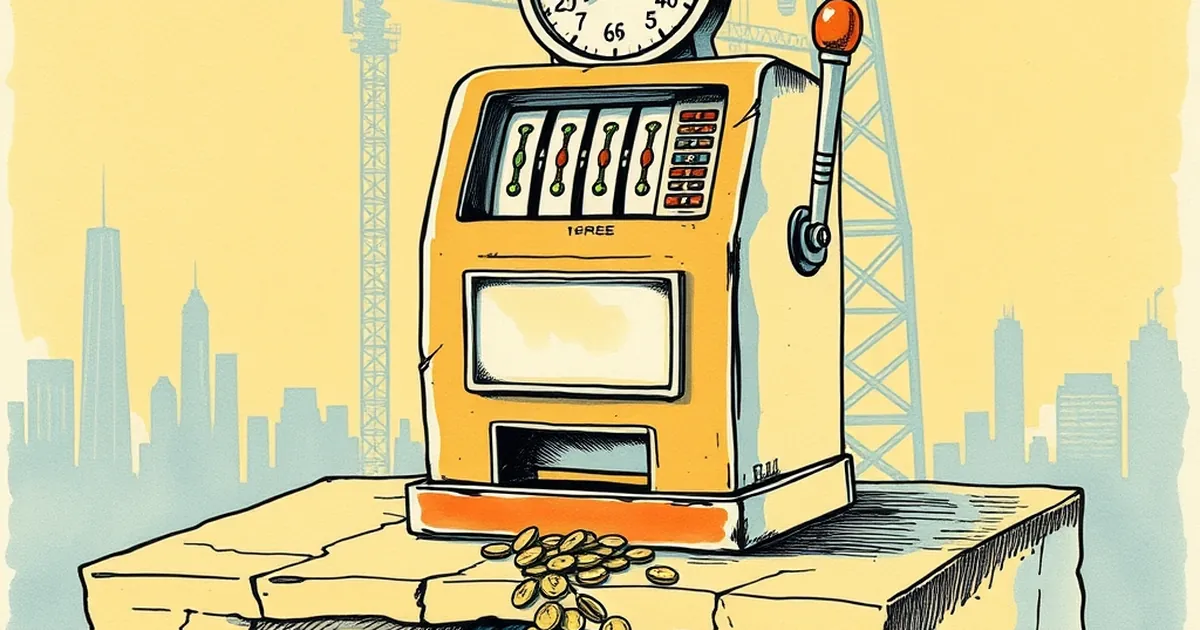
A slot advertised at 96% RTP does not return 96% of your money in a session, a month, or in most cases a year of casual play. That figure is a long-run average measured across millions of spins, and the gap between how it is marketed and how it behaves is the single most expensive misunderstanding in the Polish online casino market. The trap is not that the number is false — it is that it is true in a way almost nobody playing actually experiences.
What 96% actually describes
Take a slot with a published RTP of 96.0%. The arithmetic is straightforward: across an enormous number of spins, the machine is designed to pay back 96 złoty for every 100 złoty wagered, and keep 4. That 4% is the house edge, and it is the operator's gross margin before taxes, licensing, and the cost of the software itself.
The word doing all the work here is "across." A 96% RTP is a statement about a theoretical infinite sequence of spins. It is not a promise about your 200 spins on a Tuesday night, and it is not a budget. In a session of a few hundred spins, the variance — the natural spread of outcomes — is so wide that your actual return could plausibly be 40% or 180% of what you staked. The 96% only emerges when the sample gets large enough that the randomness averages out.
For a player, that averaging-out point is far away. On a medium-volatility slot at roughly 500 spins per hour, you would need something on the order of 100,000 spins — around 200 hours of continuous play — before your personal results start to converge meaningfully toward the published figure. Almost no casual player gets anywhere near that. The number you are shown describes a player who does not exist.
The number on the box is not the number in the game
A more practical problem sits underneath the RTP discussion, and it catches out even experienced players in Poland: the same slot title can ship with different payback settings.
Slot providers commonly build a game with several RTP configurations — for example 96.2%, 94.5%, and 92.0% — and let the operator choose which version to deploy. The game looks identical. Same graphics, same sounds, same bonus features, same name in the lobby. The only difference is the maths inside, and the lower configuration quietly widens the house edge by two to four percentage points.
This matters more than most players realise. Moving from 96% to 92% does not reduce your expected loss by a rounding error — it doubles it. At 96% RTP the house edge is 4%; at 92% it is 8%. Over a long session, that is the difference between losing 40 złoty per 1,000 złoty wagered and losing 80. The volatility feels the same. The bonus rounds look the same. The drain on your balance is not.
Under Polish law, licensed operators must publish game rules and information, and reputable ones do disclose RTP — but the disclosure is often buried in a paytable screen or a help file rather than shown next to the game in the lobby. A player who never opens that screen is choosing a game without knowing which of its versions they are playing.
Where to actually look
The RTP figure, where it is published at all, usually lives in the game's information or paytable menu, not on the tile you click to launch it. On some titles it appears as a single number; on others you will see a range, which is itself the tell that multiple configurations exist. If a slot shows "RTP 92–96.5%" rather than one figure, you are looking at a game that ships in several versions, and the version in front of you is whichever one the operator selected.
Why the headline percentage is the wrong thing to optimise
RTP is a useful comparison tool, but it is a poor predictor of what a session feels like, and Polish players tend to over-weight it for exactly that reason.
Two slots can both sit at 96% RTP and behave completely differently. A low-volatility game will dribble out frequent small wins and grind your balance down slowly and predictably. A high-volatility game at the same RTP will swallow hundreds of spins with nothing, then pay a large multiple if the bonus lands. The long-run return is identical. The experience — and the risk of busting your balance before the bonus ever arrives — is not.
This is where the 96% figure becomes actively misleading. It implies a steady, near-fair exchange: put in 100, get back 96. Real slots do not work that way at any RTP. The return is delivered in lumps, at unpredictable intervals, and a player with a 200 złoty balance and a 1 złoty spin can be wiped out long before the maths has any chance to express itself — regardless of whether the game is 92% or 97%.
The Polish regulatory environment sharpens the point. Online casino play sits outside the state monopoly that governs most gambling here, which means the market is served by offshore operators licensed elsewhere — Curaçao, Malta, and similar jurisdictions. Those licences impose their own rules, but they do not give a Polish player the same recourse as a domestic regulator would. If a game's published RTP turns out not to match its actual behaviour, the player's route to a complaint is longer and less certain than it would be in a fully domestically regulated market. That is an argument for reading the paytable carefully, not for trusting the lobby tile.
The number that matters is the one you set yourself
If RTP is a poor guide to a single session, the figure that actually governs your outcome is the one you choose before you start: your deposit limit, your stake size, and your stop point.
Poland requires licensed operators to offer deposit limits and self-exclusion tools, and offshore sites serving Polish players generally provide similar controls. Set a monthly deposit cap and the RTP debate becomes academic to your bank balance — you cannot lose more than you have decided to put in, whatever the maths does. Skip that step and no RTP figure, however high, will protect you, because the house edge is applied to every spin and the only variable fully under your control is how many spins you take.
A practical rule that costs nothing: treat the advertised RTP as a rough quality signal when comparing two otherwise similar games, and treat everything else — volatility, stake size, session length, and your own limits — as the things that actually determine whether you finish the night up, down, or out.
The uncomfortable question the industry does not rush to answer is whether a payback percentage that only manifests over 100,000 spins should be the headline number shown to players at all. It is accurate. It is also, for anyone playing a normal session, close to meaningless — and the gap between those two facts is where the money goes.