September 2026
The cement terminal that outlived its railway
How a cement terminal in Karsy kept running after its railway went silent, and what that reveals about Poland's shifting construction logistics
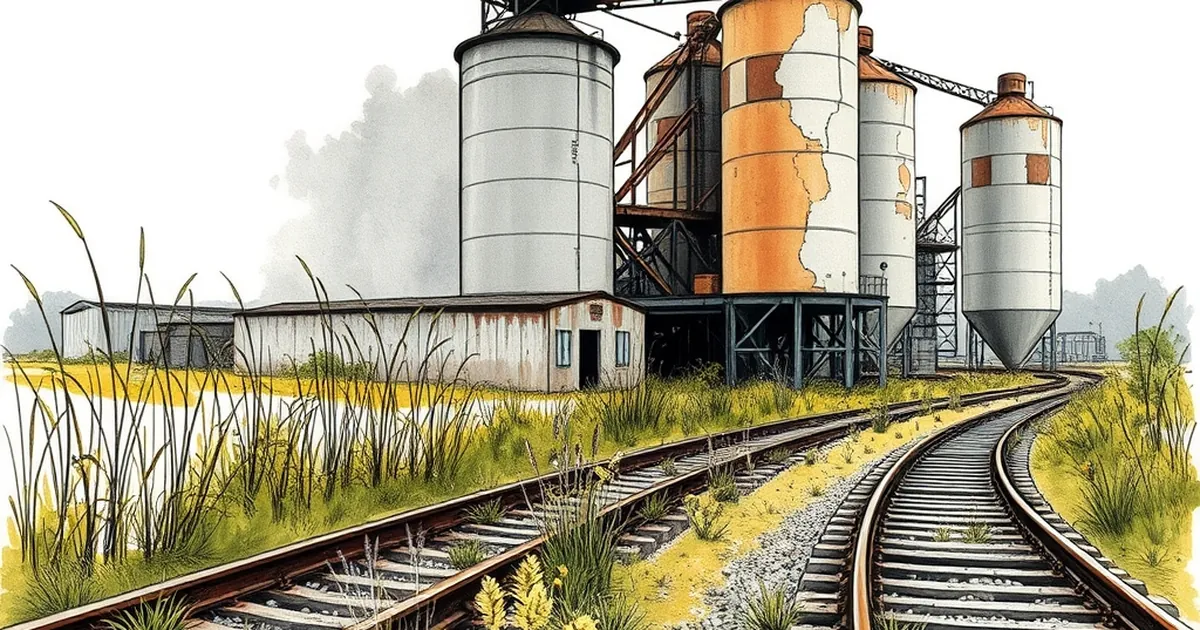
The cement terminal at Karsy sits on a side spur that hasn't felt a freight wheel since 2014. Its silos are full, its truck bay runs six days a week, and the loading gantry still bears the logo of a railway that no longer comes. How does a facility built entirely around rail freight keep operating when the tracks beneath it go quiet?
The answer says a lot about how Poland's construction logistics have quietly rewired themselves over the past decade — and what that means for the smaller towns that host this kind of infrastructure.
A terminal designed for a railway that no longer arrives
Karsy is a real place, though I'm using it here as a stand-in for a pattern repeated across a dozen Polish locations. The terminal was commissioned in the late 1990s, when cement from the Świętokrzyskie plants still moved primarily in bulk wagons. The layout reflects that assumption: a single-track siding of roughly 400 metres, a wagon tippler, two loading bays under a covered gantry, and a truck exit that was originally treated as an afterthought.
For about fifteen years, the model worked. Cement arrived in covered hoppers, was discharged pneumatically into silos, and left by truck only for the last 30–50 kilometres. Rail did the heavy lifting; road did the capillary work.
Then the economics shifted. Track access charges rose, the number of wagonload customers on the line fell, and the local freight timetable thinned from daily to three times a week, then to on-demand. By 2014, the operator had stopped running the service entirely. The rails stayed. The terminal stayed. The cement still had to move.
What actually changed
The terminal's owners did what any sensible operator does: they replaced the inbound leg with trucks. Silo capacity, which had been sized for weekly wagon deliveries, now had to absorb daily road deliveries from plants 120–180 kilometres away.
That sounds like a downgrade. In practice, it was a rebalancing. The terminal kept its most valuable asset — proximity to a cluster of ready-mix plants and precast yards — and swapped a rigid, schedule-bound supply chain for a flexible one.
Why the silos outlasted the sidings
The infrastructure that survived tells you which parts were load-bearing. Silos, pneumatic conveying, weighbridges, dust extraction, and the truck loading bays all stayed. The wagon tippler was mothballed. The siding was left in place but effectively abandoned, its switches eventually seized.
There's a lesson in that split. Cement terminals are not really railway facilities. They are storage and distribution nodes that happen to have had a railway attached. The railway was a means of inbound transport, not the purpose of the site.
The economics of a truck-only terminal
Running the numbers roughly: a single rail wagon carries around 60 tonnes of cement. A bulk tanker truck carries about 30 tonnes. A daily train of 20 wagons once delivered 1,200 tonnes in one movement; today that same volume arrives on 40 truck trips spread across the week.
The cost per tonne-kilometre is higher by road — often two to three times higher over long distances. But the terminal isn't paying for the whole journey. It's paying for the inbound leg from a plant that may itself have shifted its outbound logistics toward road. And it gains something rail could never offer: the ability to match deliveries to actual demand from ready-mix plants, which are notoriously volatile.
A single large pouring job can absorb 300 tonnes of cement in a day. Under rail supply, that meant either holding large buffer stocks or risking a stockout. Under road supply, the terminal can call in extra tankers with a day's notice.
The environmental ledger
This is where the story gets uncomfortable for anyone who wants a tidy narrative. Rail freight produces roughly 70–80% less CO₂ per tonne-kilometre than road. A terminal that switches from rail to road is, on paper, a climate regression.
But the picture is more complicated at the system level. The cement itself still travels from the same plants. What changed is the mode of the final 150 kilometres. Meanwhile, the terminal's outbound deliveries were always by truck, and those haven't increased. The net emissions increase is real but bounded — typically in the range of 15–25% of the terminal's total logistics footprint, not a doubling.
That's not a defence. It's a calibration. The climate cost of losing rail freight is significant but it isn't infinite, and pretending otherwise makes it harder to have a serious conversation about which rail connections are worth defending.
The wider pattern across Poland
Karsy is not an outlier. Poland has seen a steady erosion of wagonload rail freight since the early 2000s, driven by a combination of factors that are structural rather than cyclical.
What's driving the shift
- Track access charges that make short-haul wagonload traffic uncompetitive against road.
- Consolidation of cement production into fewer, larger plants, which changes the geography of flows.
- The rise of ready-mix concrete, which demands just-in-time cement delivery that rail schedules struggle to match.
- Road investment, which has improved truck journey times on many corridors.
The result is that many terminals built around rail have had to choose between adapting or closing. The ones that adapted — like Karsy — kept their silos and their customers. The ones that didn't are now brownfield sites with rusting gantries.
What survives, and why
The terminals that adapted share a few characteristics. They are close to dense construction markets. They have enough silo capacity to buffer several days of demand. They have flexible truck access and don't depend on a single customer.
The ones that failed were often in peripheral locations, dependent on one or two large customers, or lacked the capital to reconfigure their inbound logistics. Rail was their only viable supply mode, and when it went, so did they.
A practical takeaway for anyone watching this sector
If you're evaluating a cement terminal, a quarry, or any bulk-handling facility in Poland today, don't ask whether it has a rail connection. Ask whether it needs one.
A siding is a liability if it's unused — it costs money to maintain, it occupies land, and it signals a business model that may no longer exist. A siding is an asset only if the volumes justify it and the operator has the commercial relationships to keep trains running.
The more useful question is whether the facility's core function — storage, processing, distribution — remains viable without rail. If the answer is yes, the terminal has a future. If the answer is no, the railway isn't coming back to save it.
Karsy's silos are still pouring cement into trucks every working day. The tracks beside them are quietly rusting. Both facts are true, and both tell you something about how infrastructure actually ages in a market economy: not all at once, and not always in the way the original designers expected.