November 2026
Tram passengers trust a 3-minute countdown more than the tram itself
A 3-minute tram countdown shapes passenger behavior more than the tram itself, revealing how small promises of certainty earn everyday trust
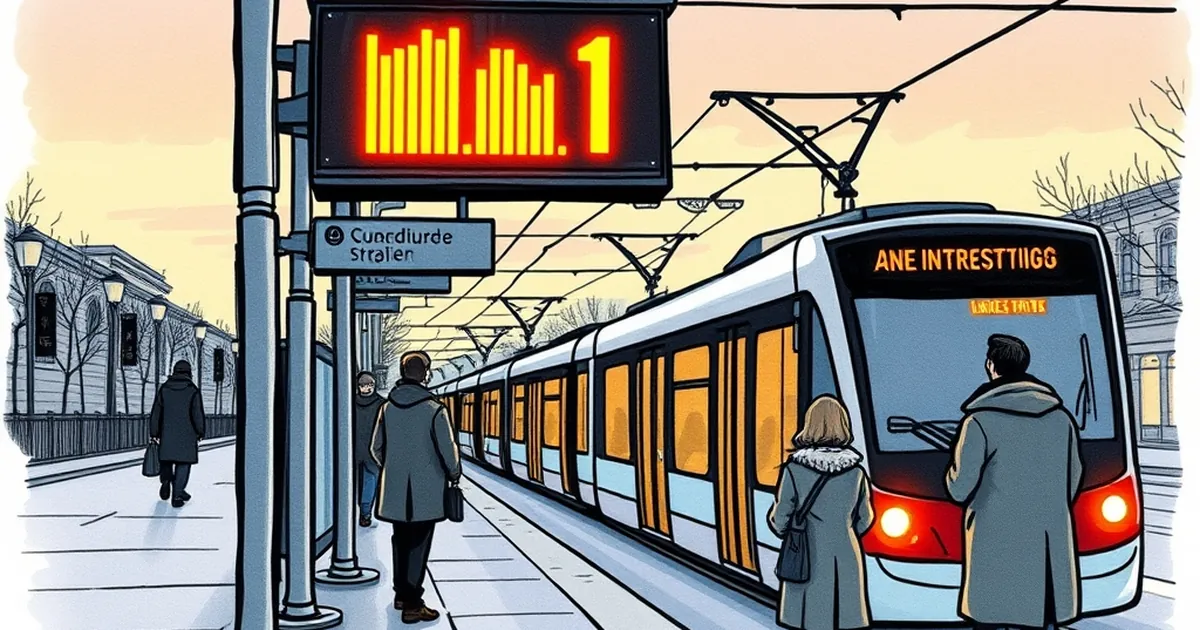
Standing on the platform at Warsaw's Świętokrzyska or the Rondo Mogilskie in Kraków, we seem to enter into a small contract with a screen. The display says three minutes, and we believe it. Not entirely, not blindly, but enough to decide against lighting a cigarette, against running to the kiosk, against calling the person waiting for us to say we'll be late. The curious thing is that the same passenger who doubts the punctuality of the entire municipal transport system — who has a mental archive of every unexplained twenty-minute gap on the 4 or the 52 — will reorganise a small slice of their day around a number generated by a GPS beacon and a scheduling algorithm. Why does a countdown command more trust than the vehicle it describes?
The countdown as a promise, not a prediction
There is a subtle but important distinction between what the display promises and what the timetable claims. The printed timetable is a document of intent: it tells you when the tram should arrive, and every passenger in Poland has learned to treat it as aspirational. The countdown, by contrast, presents itself as a measurement. It is not saying "the tram is scheduled for 14:07"; it is saying "the tram is 900 metres away and moving at 22 km/h." The first is a promise made by an institution, and institutions in Polish public transport have a credibility problem built up over decades. The second is a reading from an instrument, and instruments feel like facts.
This is a well-documented asymmetry. People extend more trust to a system that appears to report on itself than to one that appears to commit to a future state, even when both rest on the same underlying data. The countdown's authority comes precisely from its narrowness: it does not claim to know anything about the tram's driver, the track works at Mogilska, or whether the vehicle will be short-turned at the last depot. It claims only a number of minutes. That modesty reads as honesty.
Why "two minutes" feels more real than "14:07"
A clock time is abstract. You have to do arithmetic to convert 14:07 into a decision, and the arithmetic is contaminated by everything you know about 14:07 trams. "Two minutes" arrives pre-digested. It is already a decision, not a piece of information. The passenger isn't evaluating a schedule; they're reacting to a countdown, and countdowns are psychologically closer to a physical sensation than to a document. This is the same reason a countdown timer on a platform feels more urgent than a departure board listing the same train.
What the variable-ratio schedule teaches us about platform behaviour
Behavioural psychology has a useful frame here, though it needs careful handling. Variable-ratio reinforcement — the pattern in which a reward arrives after an unpredictable number of responses — is the classic explanation for why intermittent, uncertain rewards produce persistent behaviour. A countdown that is usually right but occasionally wrong is, in effect, a variable-ratio system. The passenger who has been burned by a countdown that said "1 minute" for six minutes does not abandon the display. They recalibrate, check it again, and keep checking. The occasional failure strengthens the checking habit rather than breaking it, because the next accurate countdown delivers a small, disproportionate relief.
This is not a pathology. It is how humans manage uncertainty in environments they cannot control. The alternatives on a platform — asking a stranger, reading the paper timetable, guessing — are worse. The countdown wins not because it is reliable but because it is checkable. Each glance is a fresh roll of the dice, and each accurate glance is a small reward. The behaviour persists.
Loss aversion on the platform edge
Kahneman and Tversky's work on loss aversion suggests that losses loom larger than equivalent gains. On a platform, the relevant loss is not money but time and dignity: the shame of sprinting for a closing door, the twenty minutes lost to a missed connection. A countdown that says "3 minutes" lets you avoid the sprint. A countdown that says "1 minute" when the tram is actually four minutes away produces a loss — the wasted dash, the embarrassment — that feels considerably larger than the equivalent gain from a countdown that was accurate. Passengers therefore treat the display defensively. They build in a buffer. They leave the kiosk at "4 minutes" rather than "2." The countdown is trusted, but trusted the way you trust a weather forecast: useful, and never quite the whole story.
The three-minute window and the architecture of small decisions
Three minutes is not an arbitrary number. It is roughly the length of a decision window in which a person can still act — buy a ticket, finish a call, walk to the correct end of the platform — without feeling rushed. Longer than that, and the countdown becomes background noise; shorter, and it becomes a command. Transport planners who study dwell times and platform crowding have long known that passengers cluster their behaviour around these thresholds. The countdown display, whatever its designers intended, has become a scheduling device for human behaviour as much as for trams.
There is a concrete example worth citing from the research on passenger information systems: studies of real-time departure displays in European cities have consistently found that passengers report higher satisfaction with systems that show relative time (minutes remaining) than with systems showing absolute time, even when the underlying prediction accuracy is identical. The display's format does more work than its accuracy. Passengers are not evaluating the data; they are evaluating the feeling of being informed.
When the countdown lies
The obvious counterexample is the countdown that freezes at "2 minutes" while the tram sits at a signal. Passengers notice. They develop folk theories about which stops have unreliable displays, which lines are "always wrong," and which screens to ignore. This is not irrational — it is Bayesian updating with limited data. But it is also revealing: the passenger who has been misled by a countdown a dozen times will still check it on the next platform. The behaviour is sticky in a way that a paper timetable never was. The countdown has become part of the ritual of waiting, and rituals are hard to abandon even when their predictive value is questionable.
What this means for the next generation of passenger information
The forward-looking question is not whether countdowns are accurate but what happens when they become more so. Real-time tracking in Polish cities is improving: GPS on vehicles, better integration with traffic signals, more granular predictions. As accuracy rises, the countdown's psychological authority will rise with it — and so will the cost of the occasional failure. A system that is right 95% of the time trains passengers to trust it absolutely, which makes the remaining 5% feel like betrayal rather than noise.
The design implication is counterintuitive. The most trusted countdown may not be the most precise one but the one that communicates its own uncertainty honestly — a range rather than a single number, a "2–4 min" that acknowledges the signal at the junction. Passengers already build buffers into their behaviour; a display that admitted the buffer existed would be trusted more, not less, because it would stop pretending to be an instrument and start behaving like a partner in the decision. The three-minute countdown earns its trust by being narrow, checkable, and occasionally wrong in ways passengers can forgive. The next version should earn it by being honest about the "occasionally."