October 2026
Two-Thirds of Drivers Brake Later Than Their Own Estimate
Drivers consistently overestimate their own caution, braking dozens of metres later than they believe, a gap with real consequences for road safety in Poland
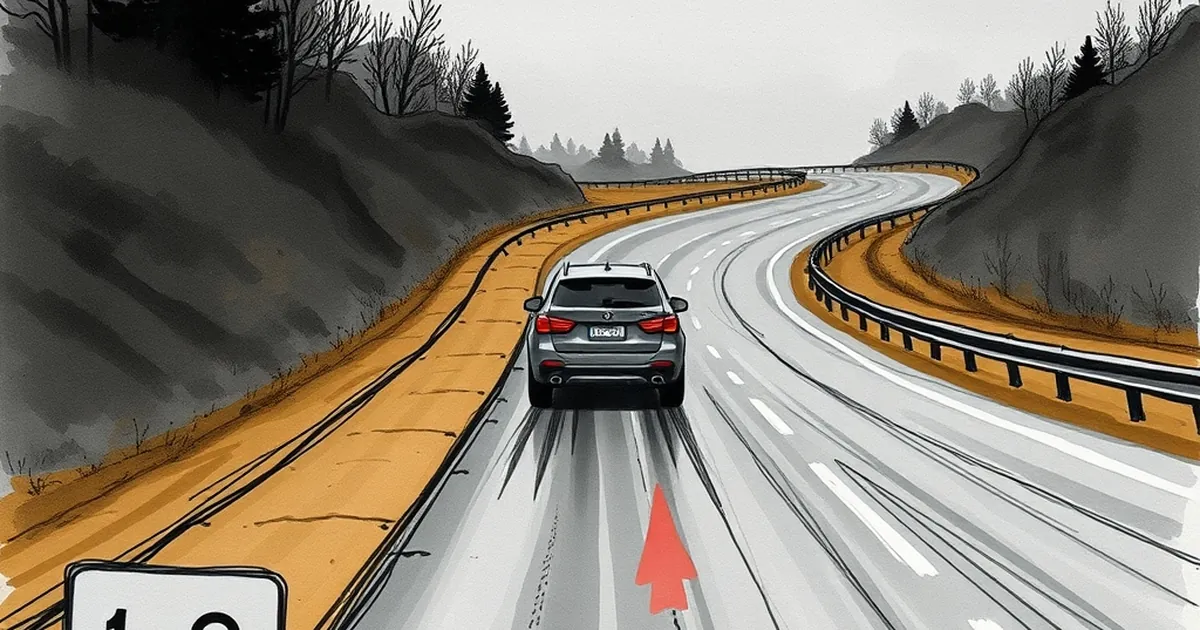
Ask a driver when they start braking for a motorway exit and most will give a confident, tidy answer. Measure the same driver on the same exit and the gap between the claim and the act is often measured in dozens of metres. That gap — between what we believe about our own behaviour and what our feet actually do — is one of the most useful things anyone working on Polish roads can understand.
The estimate and the act
The claim in the headline comes from a pattern that shows up again and again in driving research: people consistently overestimate their own caution. It is not vanity so much as a quirk of memory. Braking is a largely automatic skill, learned once and then delegated to the parts of the brain that do not keep records. When we later reconstruct what happened, we reconstruct a sensible story rather than a measurement.
The closest well-documented illustration is the classic Swedish study by Ola Svenson, published in 1981, in which a large majority of drivers rated themselves as safer and more skilful than the median driver. That is statistically impossible for a whole population, yet it feels true to almost everyone. The same self-assessment bias has since been found in dozens of replications across countries and age groups. It applies to braking distance, following distance, and phone use at the wheel — three behaviours where self-report and instrumented data diverge most sharply.
Why the foot knows better than the memory
Braking late is not usually recklessness. It is a rational response to a badly calibrated mental model.
The illusion of the average trip
Most drivers spend the overwhelming majority of their kilometres in conditions that forgive late braking: dry asphalt, moderate traffic, familiar routes. The mental model is built from that experience, and it is accurate for that experience. The problem is that the model does not automatically update for the wet November morning on the S8, the low sun on the A2, or the loaded van whose stopping distance is nothing like the hatchback the driver learned in.
Loss aversion on the road
Kahneman and Tversky's work on loss aversion describes a general human tendency: losses loom larger than equivalent gains. On the road this shows up as a reluctance to give up speed. Slowing early feels like a small, immediate loss — of time, of position, of the pleasant momentum of the journey — while the benefit, arriving safely, is abstract and almost always realised. When the two are weighed in the moment, the concrete loss usually wins.
Variable-ratio reinforcement
There is a second mechanism at work, and it is the one that makes late braking so persistent. Behaviour that is sometimes punished and sometimes not is the hardest to extinguish. A driver who brakes late is occasionally rewarded: they make the light, they keep their place, they arrive a minute earlier. Most of the time nothing happens at all. That intermittent pattern — occasional reward, frequent nothing — is precisely the schedule that behavioural psychology calls variable-ratio reinforcement, and it is famously resistant to change. A driver who has braked late a thousand times without consequence has a thousand pieces of evidence that the behaviour is fine.
What the instruments actually show
When researchers fit vehicles with sensors rather than asking questions, the picture sharpens. Naturalistic driving studies — the large-scale ones that recorded thousands of drivers over months — consistently find that measured following distances and time-to-collision margins are tighter than drivers report, and that the discrepancy grows with experience. Experienced drivers are not lying. They have simply compressed thousands of uneventful trips into a general impression of competence, and the impression is smoother than the data.
The same pattern appears in Poland's own road safety statistics. Excessive speed and late reaction remain among the most frequently cited contributing factors in serious collisions, even as overall fatality numbers have fallen substantially over the past two decades. Infrastructure has improved faster than behaviour, which is exactly what you would expect if behaviour is governed by a mental model that infrastructure alone cannot rewrite.
Designing for the driver we are, not the driver we think we are
The practical lesson is not to lecture drivers about caution. Lectures do not survive contact with a variable-ratio schedule. The lesson is to design roads, vehicles, and information so that the correct behaviour is the easy one.
Road geometry that communicates. Narrower lanes, consistent curvature, and clear sight lines do more than signs. A road that looks fast invites late braking; a road that looks like what it is invites earlier release of the accelerator. Polish road builders have absorbed much of this through the Vision Zero-influenced design standards now applied to new expressways and to the rework of dangerous national-road sections.
Vehicles that shorten the feedback loop. Automatic emergency braking and adaptive cruise control change the reinforcement schedule directly: the car intervenes before the consequence, and the driver receives feedback in the moment rather than a month later in the form of a near-miss they have already forgotten. As these systems become standard on the Polish fleet, the gap between estimate and act should narrow — not because drivers become more honest, but because the car stops letting them be wrong.
Information that meets people where they are. Variable message signs that report actual measured speeds, or that name the specific hazard ahead rather than issuing a general warning, work better than generic exhortations. The principle is the same one that makes feedback effective in any skill: specific, timely, and tied to what the person just did.
Training that targets calibration. Advanced driving courses that include instrumented feedback — showing a driver their real braking point against their estimated one — produce durable changes in behaviour that classroom instruction does not. A handful of Polish driver-training centres have begun offering exactly this, and the early results are encouraging.
The forward-looking question for anyone building or maintaining Polish roads is not how to make drivers more careful. It is how to make the gap between what drivers believe and what they do visible, small, and self-correcting — because the two-thirds who brake later than they think will keep doing so until the road, the car, or the feedback loop tells them otherwise.