October 2026
Variable-Ratio Rewards Make Polish Road Works Feel Faster
Variable-ratio rewards explain why Poland's stop-start road upgrades feel quicker than steady progress, revealing a quirk of human motivation at work
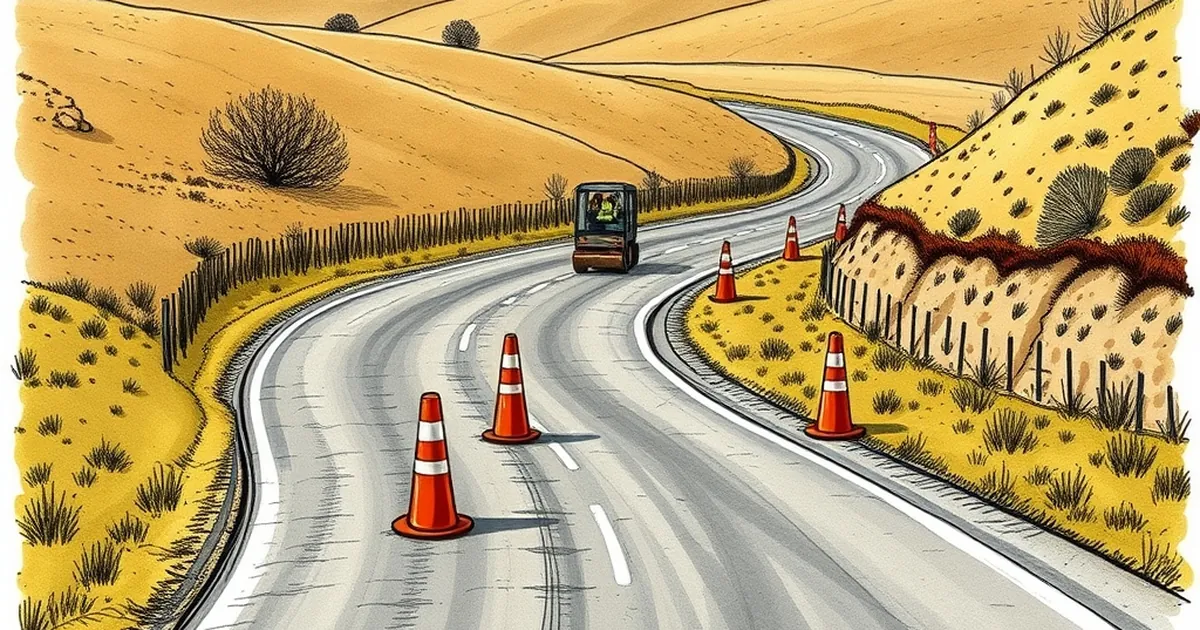
Anyone who has driven the S7 south of Warsaw in the past two summers knows the particular rhythm of a Polish road upgrade: long stretches of nothing changing, then suddenly a whole new interchange appears, then nothing again. Why does that irregular pattern feel faster than a project that advances at a perfectly steady pace? The answer sits at the intersection of construction logistics and a well-documented quirk of human motivation — the same one that makes a notification badge more compelling than a scheduled email digest.
The Psychology of the Unpredictable Gap
Behavioral psychologists have known since the 1950s that rewards delivered on an unpredictable schedule produce more persistent engagement than rewards delivered on a fixed one. B.F. Skinner's work on operant conditioning identified what he called variable-ratio reinforcement: when a subject cannot predict how many responses stand between them and the next reward, the behavior becomes more resistant to extinction. A pigeon pecking a lever that pays out after an average of twenty pecks, but sometimes after three and sometimes after forty, will keep pecking far longer than one on a fixed schedule.
This is not a curiosity confined to laboratories. The same principle explains why slot machines are engineered the way they are, why social media feeds refresh unpredictably, and why email checking is so hard to stop. But it also explains something more benign: why commuters experience road construction the way they do. The human brain, it turns out, is not a stopwatch. It is a prediction machine, and it evaluates progress against expectation rather than against a constant standard.
Daniel Kahneman and Amos Tversky's work on prospect theory adds a second layer. People weigh losses more heavily than equivalent gains — loss aversion — and they evaluate outcomes relative to a reference point rather than in absolute terms. A driver who expects gridlock and gets a clear lane experiences a gain. A driver who expects a clear lane and gets gridlock experiences a loss, even if the average travel time across both trips is identical. The reference point, not the raw number, drives the feeling.
What This Means on a Polish Road Site
Polish road construction has a structural feature that amplifies this effect: it is genuinely lumpy. A motorway upgrade is not a smooth gradient of improvement. It is earthworks, then drainage, then sub-base, then binder course, then wearing course, then markings, then barriers, then lighting, then commissioning. Each stage is largely invisible until it is nearly complete, and then it appears almost at once.
Consider the S6 expressway between Gdańsk and Szczecin, one of the largest ongoing road projects in the country. For months, a section near Słupsk looked like a scar of excavated peat and gravel — nothing a driver would call progress. Then, within a few weeks, a full dual carriageway with fresh markings materialised. For a regular user of that route, the felt experience is a sudden reward after a long dry spell. That is variable-ratio reinforcement in asphalt.
Contrast this with a resurfacing project on a city artery in Kraków or Wrocław, where work proceeds in short, predictable nightly closures. The total disruption may be smaller, but because each night delivers roughly the same amount of visible change, the perceived progress is flatter. Drivers habituate. The reward stops registering.
The Expectation Gap Is the Product
There is a practical consequence here that project managers and communication teams rarely exploit deliberately. If you tell the public that a road will be "open by late 2027," you have created a single, distant, fixed reward. Every month until then is a month of no reward. If instead you communicate the intermediate milestones — this bridge deck closes in March, this junction reopens in June, this section gets its final surface in September — you convert one distant payout into a series of nearer, less predictable ones. The unpredictability is not manufactured; it is inherent in the construction sequence. The communication just needs to stop hiding it.
GDDKiA, the General Directorate for National Roads and Motorways, has moved in this direction with more granular project dashboards and periodic photo updates, but the framing still tends toward the grand opening. The grand opening is a fixed-ratio reward. It is satisfying when it arrives and psychologically inert until then.
Loss Aversion and the Detour
There is a second behavioural force at work on any Polish road project, and it is arguably stronger than the reward loop: the detour.
When a familiar route is closed, drivers do not simply recalculate. They experience the closure as a loss relative to a baseline they had come to treat as a right. Kahneman and Tversky's central finding was that losses loom roughly twice as large as equivalent gains in subjective terms. A detour that adds twelve minutes feels worse than a clear run that saves twelve minutes feels good. This asymmetry explains why road closures generate disproportionate public anger even when the net time cost across a construction season is modest.
It also explains why the variable-ratio effect matters so much in this context. If every trip through a construction zone were equally bad, drivers would adapt their expectations downward and the loss would fade. But because the experience is irregular — some days the queue is twenty minutes, some days it is two — the good days reset the reference point upward, and the bad days then register as fresh losses. The variability that makes progress feel rewarding also makes disruption feel punishing. Both effects run on the same cognitive machinery.
A Concrete Illustration
A 2019 study published in Transportation Research Part F examined driver stress responses to variable versus consistent congestion on urban arterials. Participants who experienced unpredictable delay reported higher peak stress but also rated the overall journey as more tolerable than those who experienced the same average delay distributed evenly. The authors attributed this to what they called "relief salience" — the unpredictable good outcome is more emotionally vivid than the predictable mediocre one.
Polish road users are living this experiment daily. The S7 between Kraków and Warsaw, the S8 through the Łódź region, the A1 near Częstochowa — each has its own rhythm of closure, reopening, and sudden visible progress. The projects that feel fastest are not always the ones that are actually ahead of schedule. They are the ones whose progress arrives in unpredictable visible chunks.
Designing for the Perception, Not Just the Schedule
None of this suggests that engineers should deliberately randomise their work sequences to exploit driver psychology. That would be absurd, and the construction sequence is dictated by physics and safety, not by behavioural science.
What it does suggest is that the reporting of progress can be aligned with how humans actually process it. There is a real opportunity for Polish infrastructure communication to move away from the milestone-as-announcement model and toward something more continuous and less predictable in its cadence — a photo here, a short video there, a junction reopening announced the day it happens rather than a month in advance. The goal is not to manipulate. The goal is to stop suppressing information that already exists and that would give road users a more accurate, more granular, and frankly more motivating picture of what is happening.
The next time you drive a Polish expressway under construction, notice what you notice. It will not be the average rate of progress. It will be the moment something new appears. That moment is the variable-ratio reward, and it is doing more work on your patience than any signboard ever could.