October 2026
Warsaw orders trams it cannot store overnight
Warsaw's new tram fleet faces a critical shortage of depot space, raising questions about how a flagship transit investment will operate day to day
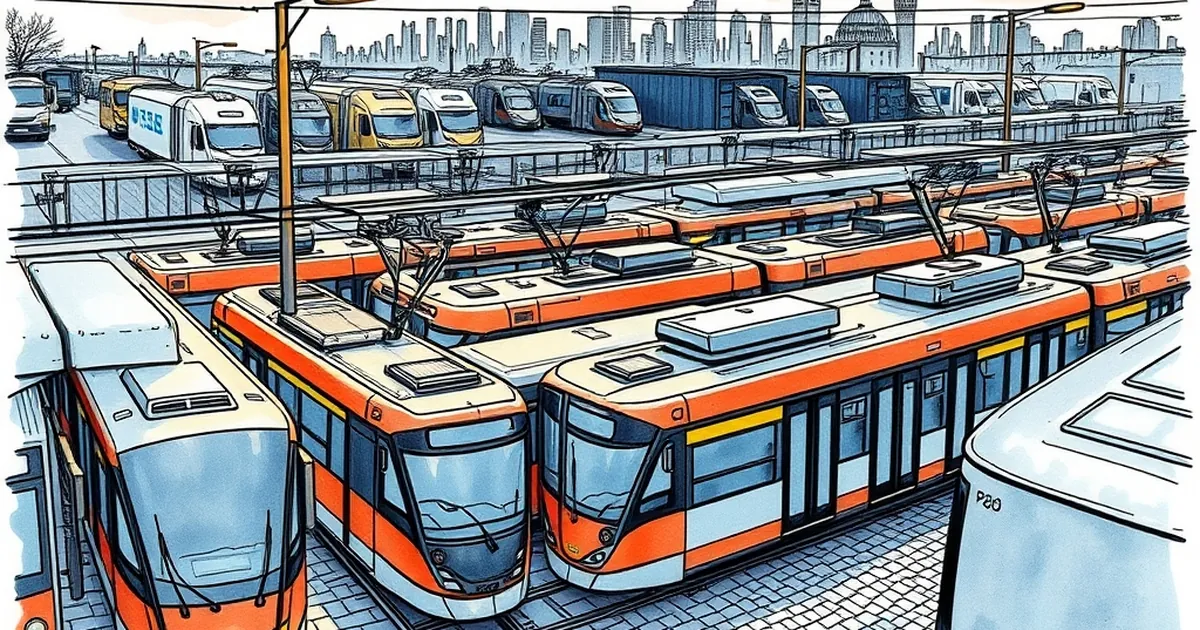
Warsaw has signed off on a major expansion of its tram fleet — and on paper, that should be unambiguously good news for a city that has spent years promising residents fewer buses stuck in traffic and more reliable rail-based transit. But there is a catch that has quietly become the talk of the city's transport planning circles: a meaningful chunk of the new rolling stock has nowhere to sleep. The trams are coming. The depots, for now, are not.
This is not a minor logistical footnote. It is the kind of mismatch that can turn a flagship investment into a daily operational headache, and it raises a question every Polish city chasing EU-funded fleet upgrades should be asking: can your infrastructure keep up with your ambitions?
The Gap Between the Order Book and the Depot Floor
Warsaw's tram network is one of the largest in Poland, and Tramwaje Warszawskie has been on a genuine buying spree. New low-floor vehicles from manufacturers like Hyundai Rotem and, in earlier tranches, Pesa and Solaris have been arriving or are on order, part of a long-term strategy to modernise a fleet that still carries a lot of ageing rolling stock. The logic is sound: newer trams mean lower maintenance costs, better accessibility, and a more attractive alternative to driving.
The problem is where these vehicles go when the last passengers step off. Trams are not buses. You cannot park a 30-metre articulated vehicle on a side street and call it a night. They need powered tracks, inspection pits, washing stations, and specialised workshops. Existing depots — R-1 at Mokotów, R-2 Praga, R-3 Annopol, R-4 Żoliborz — were designed for a different era and a smaller, differently shaped fleet. Many of them are landlocked, surrounded by dense urban fabric with no room to grow.
So the city finds itself in an awkward position: signing contracts for vehicles before the depots to house them are fully funded, permitted, and built. That sequencing gap is the real story here.
Why Depots Are the Hardest Part
Anyone who has followed infrastructure delivery knows the uncomfortable truth: depots and maintenance facilities are almost always the last thing built and the first thing delayed. They are politically invisible — no ribbon-cutting photo compares to a shiny new tram gliding down Marszałkowska. They are technically complex, requiring heavy power infrastructure, drainage, and fire systems. And they sit on large parcels of land that, in a city like Warsaw, are either expensive, contaminated, or already claimed by someone else.
A depot is also a long-lead project. From land acquisition to commissioning, you are realistically looking at five to eight years. A tram order can be delivered in two to three. That asymmetry is precisely how you end up with brand-new vehicles and no bay to put them in.
What Happens When Storage Runs Out
The consequences are not hypothetical. When a city runs short on depot capacity, it starts making compromises that ripple through the whole system.
Trams get stabled outdoors on sidings, exposed to weather and vandalism, which accelerates wear and raises maintenance costs. Inspection cycles get squeezed because there are fewer pits and less workshop time. Vehicles that should be rotated out for servicing stay in service longer. And the network loses flexibility — you cannot easily expand service on a line if there is no place to park the extra trams that service requires.
There is also a knock-on effect on the night. Warsaw, like most European cities, runs a reduced night tram network, but the vehicles still have to be distributed across depots in a way that makes the morning pull-out efficient. If storage is scattered or improvised, the first departures of the day become slower and more fragile. One late-night shunting problem can cascade into morning delays across multiple lines.
I have seen this pattern before in other Polish cities. When Poznań and Kraków expanded their fleets, both had to phase deliveries carefully against depot readiness, and both felt the pinch during transition periods. Warsaw is bigger, which means the pinch is bigger too.
The Temporary Fixes Cities Reach For
Operators typically respond with a familiar toolkit. They lease or borrow space from neighbouring networks. They accelerate the modernisation of existing depots, accepting the disruption of construction while trying to run normal service. They stagger deliveries with manufacturers — asking, essentially, for the trams to arrive later than contracted. And they look for disused industrial land that might be converted, often at significant cost and with environmental remediation attached.
None of these are free. Staggering deliveries can trigger contractual penalties or renegotiation. Temporary storage costs money and adds operational friction. And every year of delay pushes the full benefit of the fleet investment further into the future.
The Bigger Lesson for Poland's Transit Cities
Warsaw's situation is a useful mirror for every Polish city riding the current wave of EU cohesion funding into new trams, buses, and rail vehicles. The money for rolling stock is often easier to secure than the money for depots, because vehicles are visible, quantifiable, and politically rewarding. Depots are none of those things.
The cities that get this right treat the depot as the anchor of the project, not an afterthought. They secure land early, sometimes years before the vehicle tender. They sequence funding so that depot construction and fleet delivery move in parallel. And they communicate honestly with residents about the transition period, because pretending the problem does not exist only makes the eventual disruption worse.
There is also a planning-culture point here. Polish cities have become genuinely good at winning EU money and procuring modern vehicles. The next level of competence is mastering the unglamorous enabling infrastructure — depots, substations, power supply, and track renewals — that determines whether those vehicles actually deliver the service improvement they promise.
A Concrete Example Worth Watching
Look at how Warsaw handled the Annopol depot expansion versus how it has approached newer storage needs. Annopol, in the city's north-east, has been the workhorse for absorbing growth, but it cannot carry the entire burden indefinitely. The planned depot at Koziorożca and the long-discussed facility near the southern terminus are exactly the kind of projects that will decide whether the new trams become a success story or a cautionary tale. Watch those timelines closely — they matter more than the delivery dates on the vehicle contracts.
What This Means for the Rest of Us
For anyone who uses Warsaw's trams — or who cares about how public money gets spent — the practical takeaway is to pay attention to the boring parts. When your city announces a shiny new fleet, the first question worth asking is not "how many trams?" but "where will they park, and who is paying to build that?"
The forward-looking note is more hopeful than it sounds. Warsaw is not uniquely bad at this; it is simply early in a problem that will hit other Polish cities as their own fleets age and expand. The cities that start treating depots as strategic infrastructure — funded, planned, and built alongside the vehicles — will be the ones whose tram networks actually feel modern in a decade. The ones that do not will have beautiful new trams and nowhere to put them.