October 2026
What happens when a rail siding loses its last owner
Poland's disused rail sidings vanish through years of quiet bureaucracy, revealing why abandoned freight lines matter beyond the industry itself
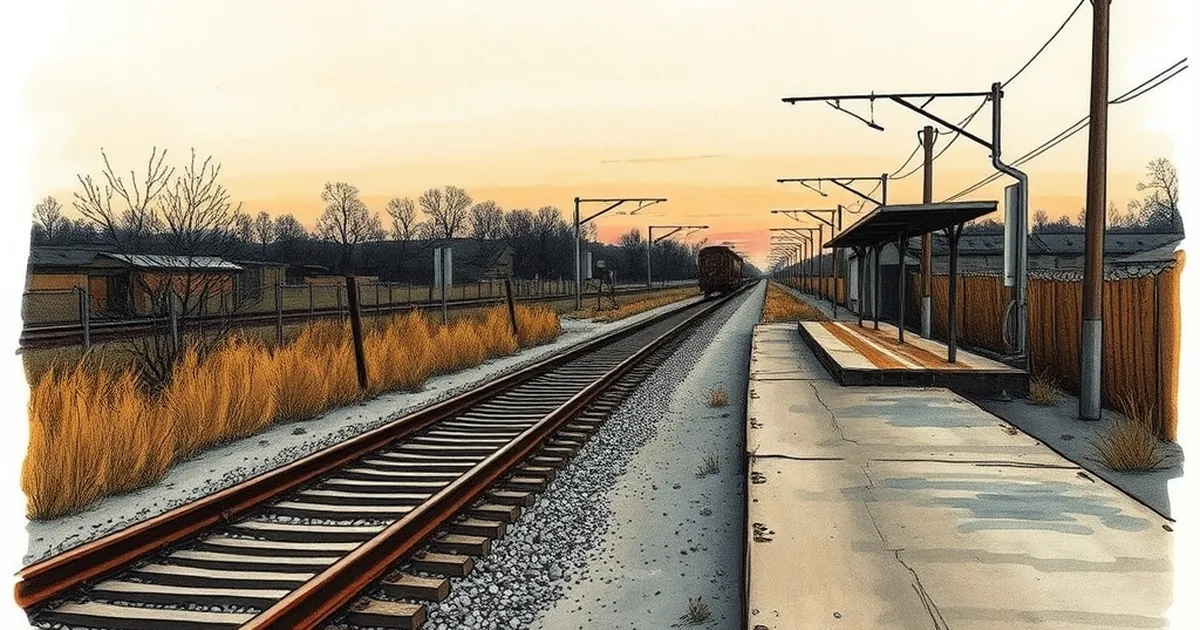
Every few months, another short spur of track somewhere in Poland quietly stops being a railway. The buffer stops rust in place, the turnout gets lifted, and a line that once carried coal, timber or sugar beet becomes a footpath between housing estates. What actually happens when a rail siding loses its last owner — and why should anyone outside the freight business care?
The slow death of a siding is rarely dramatic
A rail siding does not disappear overnight. Its decline is a bureaucratic process measured in years, sometimes decades, and it usually begins long before the last wagon rolls.
Under Polish law, railway infrastructure is regulated by the Office of Rail Transport (UTK), and lines are formally classified. A siding (bocznica) is not the same as a public railway line — it belongs to its owner, often a factory, a mine, a port operator or a logistics company. When that owner goes bankrupt, restructures, or simply stops needing rail, the infrastructure enters a legal limbo that is far messier than most people imagine.
First the traffic stops. Then the maintenance stops. Then the vegetation takes over. Only after that does anyone ask the legal question: who is now responsible for this strip of land, these rails, and the level crossing where the siding meets a public road?
The ownership chain nobody wants to inherit
Polish business history since 1989 has produced thousands of these cases. A state-owned plant is privatised, the new owner sheds rail operations, the property is split between several successors, and the siding ends up attached to a parcel nobody claims. Land registry entries (księgi wieczyste) can be incomplete or contradictory, and the local authority discovers it has a railway crossing on its hands that no one is maintaining.
UTK has, over the years, formally "liquidated" a substantial number of sidings — removing them from the register of railway infrastructure. That sounds tidy. In practice it transfers a set of obligations to someone else: demolition, land reclamation, or simply the duty to keep a disused structure from becoming a hazard.
Who pays when the rails go quiet?
This is where the story gets expensive, and where local governments get a very unwelcome letter.
The crossing problem
A siding that crosses a public road has a level crossing, and level crossings carry legal obligations regardless of whether trains still run. Someone must maintain the surface, the signs and the sight lines. When the siding owner vanishes, municipalities frequently find themselves maintaining infrastructure that generates zero revenue and carries a real liability risk. I have spoken with local officials who discovered a dormant crossing only when a pothole complaint landed on their desk.
Land, contamination and the tax bill
Rail land is rarely clean land. Old sidings come with diesel contamination, asbestos from brake linings, and subsoil compacted by decades of heavy axle loads. Redevelopment is possible — and increasingly common — but the remediation bill lands before the first apartment block does.
Meanwhile, the property tax question grinds on. Is a disused siding "railway infrastructure" (taxed differently) or ordinary land? Different interpretations in different gminas have produced years of disputes.
A concrete example from Upper Silesia
Consider the fate of the many sidings that once served Silesian steelworks and coal mines. After the 2015–2018 restructuring of the coal sector, several plants closed with sidings still physically connected to the national network. In one case I followed, a former coking plant siding sat untouched for four years while the insolvency administrator, the municipality and the State Treasury argued over who owned the turnout connecting it to the main line.
The turnout itself was the crux. Removing it would have cost several hundred thousand złoty and required coordination with PKP Polskie Linie Kolejowe, because it sat within the boundary of an active line. Leaving it in place meant the main line's signalling and safety documentation had to account for a connection that nobody was using. The deadlock was eventually broken when a logistics developer bought the site for warehousing — and paid for the turnout removal as part of the deal. That is the typical resolution: not a legal one, but a commercial one.
Can a dead siding come back to life?
Sometimes, yes — and that is the part of this story worth watching.
Poland's freight market has changed shape. Container traffic through Baltic ports has grown, and with it the demand for inland terminals. A disused siding in the right place, near a motorway junction or an industrial park, is suddenly an asset again. Several developers now specialise in acquiring dormant rail land precisely because the connection to the national network is the hard part to recreate.
The catch is the connection
Reconnecting a siding to a live line is not a matter of laying rails. It requires a technical study, agreement with the infrastructure manager, signalling compatibility, and — crucially — someone willing to fund it. The EU's Connecting Europe Facility and regional operational programmes have funded some terminal projects, but the queue is long and the criteria favour large-scale facilities.
For smaller sites, the economics rarely work. A siding serving one warehouse is a cost centre. A siding serving a cluster of them can be viable. That is why the future of Poland's surviving sidings probably lies in shared-use terminals rather than single-factory spurs.
What to watch if you own or inherit one
If you are a municipality, a developer or a company that has just discovered a dormant siding on its books, the practical sequence is clear. Establish the legal status with UTK first — is the siding still registered, and who is the infrastructure manager of record? Then check the land registry, then commission a technical survey of the connection point. Do this before you commission any redevelopment plan, because the turnout, not the land, usually decides the project's fate.
The bigger picture is a slow, quiet thinning of Poland's rail freight network at its edges, while the core corridors grow busier. That is not necessarily a bad outcome — but it does mean that every dead siding is a decision, not an accident. The ones worth saving are the ones someone is willing to pay to reconnect, and the sooner that conversation starts, the cheaper it gets.