October 2026
Who inspects Poland's temporary bridges once they open?
Poland's temporary bridges pass through a layered inspection chain from site engineer to regional building inspectorate, with checks continuing long after op...
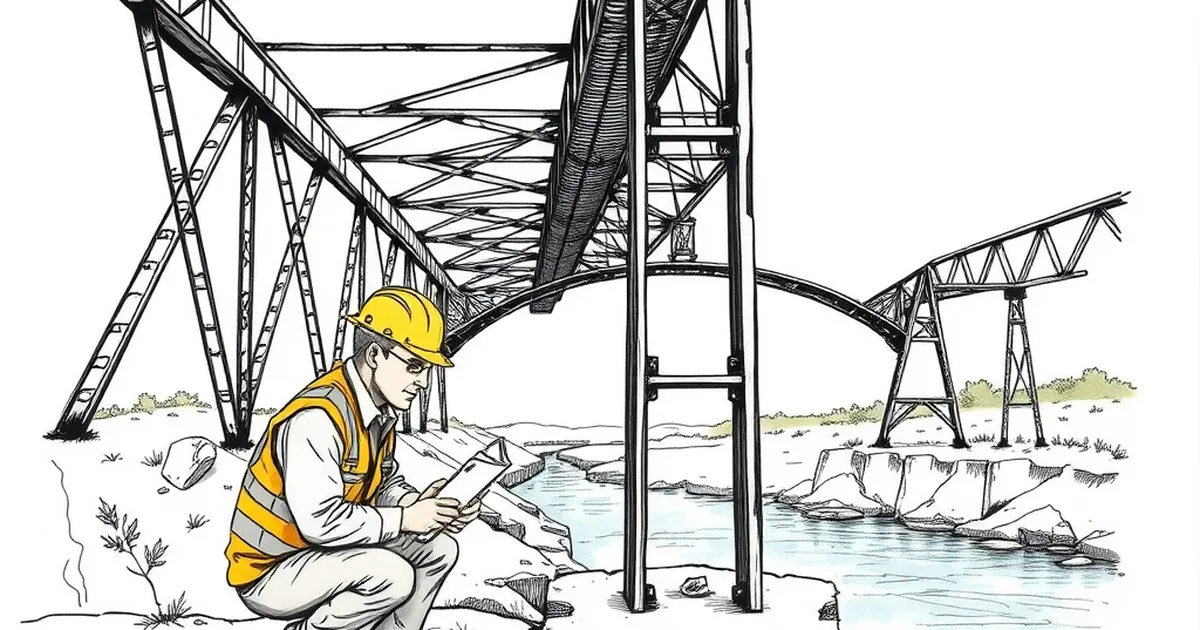
A temporary bridge goes up in a few weeks, carries traffic for a year or two, and then quietly disappears. Who signs off on it before the first car rolls across — and who comes back to check it six months later, when the novelty has worn off and the asphalt is settling? The answer is more layered than most drivers assume, and it involves a paperwork chain that stretches from the site engineer's office all the way to the regional building inspectorate.
The legal status of a "temporary bridge" — and why it matters
In Polish construction law, a tymczasowy obiekt budowlany (temporary building structure) is defined by its intended lifespan, not by its materials. A modular steel truss bridge erected for a detour during a road reconstruction is legally temporary. So is a Bailey-type crossing installed after a flood washes out a county road.
That classification drives everything about inspection. A temporary structure still requires a building permit or a notification, depending on its scale, and it still passes through the same odbiór (acceptance) procedure as a permanent bridge. The difference lies in the time horizon: the permit specifies an expiry date, and the structure must be removed or legalised by then.
Here's the part that surprises people. A temporary bridge is not a lower standard of safety. The relevant technical conditions — rozporządzenie w sprawie warunków technicznych, jakim powinny odpowiadać drogowe obiekty inżynierskie — apply to the design regardless of how long the bridge will stand. A detour crossing designed for 40 tonnes has to actually carry 40 tonnes safely, whether it serves traffic for eighteen months or fifty years.
Who actually performs the inspections
The acceptance stage: powiatowy inspektor nadzoru budowlanego
Before any temporary bridge opens, the investor must notify the Powiatowy Inspektor Nadzoru Budowlanego (PINB) — the county-level building supervision inspectorate — of completion. The PINB has 14 days to review the documentation and either object or allow the structure into service.
The documentation package is substantial: the design, the construction log, as-built drawings, geotechnical reports for the abutments, material certificates for the steel, and the results of load testing where required. For temporary crossings, load testing is often mandatory precisely because the structure is modular and assembled on site rather than fabricated under factory conditions.
The PINB inspector does not personally verify every bolt. Their role is to confirm the paperwork chain is complete and that the kierownik budowy (site manager) and inspektor nadzoru inwestorskiego (investor's supervision inspector) have signed off on the works. That delegation is normal — but it means the real technical scrutiny happens earlier, in the hands of people hired by the investor.
Ongoing supervision: the grey zone
Once the bridge is open, routine technical inspections fall to the zarządca drogi — the road authority, whether that's a gmina, powiat, or the General Directorate for National Roads and Motorways (GDDKiA). Polish law requires periodic inspections of road structures: bieżące (routine, at least once a year), okresowe (detailed, every five years), and doraźne (ad hoc, after incidents or extreme weather).
For a temporary bridge, these intervals are usually tightened in the permit conditions. A modular structure on temporary abutments settles differently than a permanent one, and joint movements need watching. In practice, many road authorities schedule inspections every three to six months for temporary crossings.
The PINB retains oversight but does not conduct routine inspections. It intervenes when something goes wrong — a reported defect, a complaint, or a construction disaster. Between those events, the bridge is the road manager's responsibility.
The weak point nobody advertises
I spoke with a site engineer in Małopolska last year who described the pattern plainly. His firm had installed a temporary crossing over a river during a bypass project. The bridge opened in autumn. By the following spring, the road authority's inspection schedule had been postponed twice because the inspector responsible covered four other structures and a staffing gap.
Nothing failed. But the anecdote illustrates the structural weakness: temporary bridges sit at the intersection of two systems — building supervision and road maintenance — and neither treats them as a top priority. They are, by definition, someone else's problem in eighteen months.
There's also the question of documentation handover. When a temporary bridge serves a detour, the investor is often the contractor, not the road authority. The handover of as-built documentation and inspection obligations to the eventual road manager is sometimes sloppy. I've seen cases where the road authority inherited a bridge with incomplete records and no clear inspection history.
What changed after the 2019 disasters — and what didn't
The collapses of the DK61 bridge in January 2019 and later the temporary pedestrian bridge failures pushed the GDDKiA and the Główny Inspektor Nadzoru Budowlanego to tighten reporting. Digital construction logs became mandatory, and the Central Register of Construction Works now tracks temporary structures more systematically.
What didn't change is the fundamental split: design and construction review happen at acceptance, then routine care transfers to a road manager with finite resources. For temporary bridges, that gap matters more because the structure is, by design, less forgiving of deferred maintenance.
What to watch for if you're the one signing off
If you're an investor, a road authority, or a contractor handing over a temporary crossing, the practical checklist is short but unforgiving. Confirm the permit's expiry date is written into the handover documents. Verify the inspection schedule is agreed in writing with the receiving road manager, not assumed. And insist that the as-built documentation includes the load test results and abutment settlement measurements — those are the numbers the next inspector will need.
The forward-looking point is this: as Poland's road modernisation programme keeps generating detours, temporary bridges will multiply. The inspection regime exists on paper. Making it work in practice means treating the handover moment as seriously as the opening ceremony.