October 2026
Why Poland's temporary bridges outlive their paperwork
Poland's temporary Bailey bridges keep carrying traffic long after their permits expire, revealing a quiet gap between infrastructure and legality
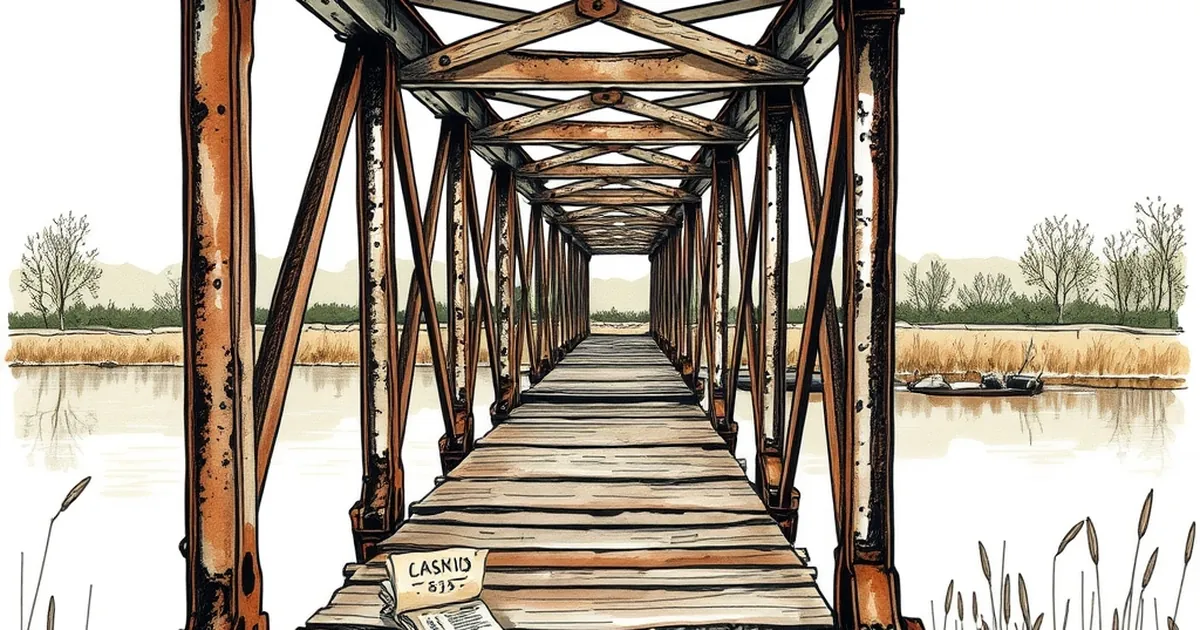
Drive across the S8 near Wyszków or take a secondary road through Mazovia and you will eventually meet one: a steel Bailey-style bridge, grey and riveted, carrying traffic that its designers never imagined. The curious thing is not that these structures exist. It is that so many of them are still standing years after the temporary permits, decisions and paperwork that allowed them to be built have quietly expired. How does a bridge outlive its own legality — and why does nobody seem to be in a hurry to fix it?
The strange life cycle of a "tymczasowy" bridge
Polish road administration has a long tradition of the bridge tymczasowy — the temporary bridge. Some were built after wartime destruction, some as detours during major rebuilds, and many more during the infrastructure boom of the 2000s and 2010s, when a closed crossing could strangle a whole powiat's economy.
The paperwork that authorises them is, by design, short-lived. A temporary road structure typically gets a fixed-term permit, often tied to the duration of a construction contract or a stated number of years. Once that date passes, the bridge is technically in a legal grey zone: physically present, functionally indispensable, formally expired.
Here is where reality bites. A detour bridge that was supposed to serve for eighteen months becomes the only crossing over a river for a decade. Residents name it, use it daily, and build their commutes around it. The document says "temporary." The community says "ours."
Why the paperwork expires faster than the need
The mismatch is structural, not accidental. Permits are written against a project timeline. Need is measured against demographics, local business patterns and the next nearest bridge — which might be twenty kilometres away.
When a contractor finishes and moves on, the legal rationale for the temporary structure evaporates with the contract. But the traffic does not evaporate. It grows, because a new housing estate got built on the far bank, or because the regional road authority rerouted a bus line over the "temporary" span.
What actually keeps these bridges standing
Three forces keep expired temporary bridges in service, and none of them is a formal decision to keep them.
Local politics. No wójt, burmistrz or starosta wants to be the official who closed the crossing. The political cost of removing a bridge is immediate and visible; the cost of leaving it is diffuse and deferred. Inertia wins.
Budget arithmetic. Demolishing a bridge costs money. Building a permanent replacement costs far more. Inspecting and patching the existing structure costs least of all — at least on this year's ledger. So the temporary bridge gets another patch, another painting, another annual inspection report with a note that says "condition satisfactory, recommend continued monitoring."
Administrative ambiguity. Responsibility for a temporary structure can fall between the General Directorate for National Roads and Motorways (GDDKiA), a marshal's office, a powiat road authority and the original contractor. When nobody clearly owns the problem, the bridge simply continues to exist in a kind of institutional fog.
The inspection regime nobody advertises
Temporary bridges are not exempt from technical inspections — Polish law requires periodic reviews of road structures regardless of their administrative status. In practice, though, the inspection standard applied to a "temporary" span can be looser than what a permanent bridge would face.
Load classifications get carried over from the original design. A bridge rated for a certain tonnage in 2008 may still carry that rating in 2024, even though the steel has cycled through millions more fatigue loads and the deck waterproofing has aged well past its service life. The paperwork says the bridge is temporary. The inspections, subtly, treat it as if it were permanent — but without the capital planning that permanence would demand.
A bridge in Mazovia that refused to retire
A few years ago I followed the case of a temporary crossing over the Narew that had been installed as a detour during a bridge renovation. The renovation finished. The detour bridge stayed.
The original permit expired. The contractor left. The local gmina kept gritting it in winter because school buses used it. Farmers with heavy machinery crossed it daily. By the time anyone formally asked who was responsible for the structure, the answer had become genuinely unclear — and the bridge had been in service, unofficially, for longer than the renovation it was built to support.
What struck me was not the bureaucratic confusion. It was how normal it all felt. The bridge worked. People depended on it. The expired permit sat in a filing cabinet somewhere, irrelevant to the morning commute.
The real risk hiding in plain sight
Temporary bridges are engineered for a defined service life. Steel fatigues. Bearings seize. Concrete cracks and rebar corrodes. A structure designed for a fifteen-year working life and kept in service for thirty is not necessarily dangerous — but it is operating outside its design envelope, and the safety margin that engineers build in is being consumed silently.
The danger is cumulative and undramatic. There is no single moment when a temporary bridge becomes unsafe; there is a long slope of declining margin, masked by inspections that confirm "no critical defects" while the structure drifts further from its original assumptions.
Poland has already had bridge failures that turned into national conversations about maintenance backlogs. The lesson from those cases is consistent: the problem is rarely a single bad decision. It is a chain of small deferrals, each individually reasonable, that together produce a structure carrying loads it was never meant to carry, under a permit that expired years ago.
What should happen next — and what you can watch for
The practical fix is not glamorous. It requires three things that Polish road administration is slowly getting better at: a national register of temporary structures with explicit expiry dates and named responsible authorities; a mandatory decision point at permit expiry — either upgrade to permanent status with a full technical assessment, or decommission; and honest load re-rating as structures age.
For readers who live near one of these bridges, there is a simple civic lever. Ask your gmina or powiat road authority a direct question: what is the legal status of this bridge, and when was its last full technical inspection? The answer is often revealing. Sometimes it is a crisp document reference. Sometimes it is a long pause.
Poland's temporary bridges are a quiet monument to pragmatism — and to the gap between what is written down and what is actually true on the ground. The next round of EU-funded road investment is a natural moment to close that gap, before a structure built for a detour becomes a permanent liability nobody formally owns.