November 2026
How Slot Odds Work: Reels, RTP and What the Paytable Hides
Slot paytables show prizes, not true odds. Discover how reels, RTP and software settings really shape what a machine pays back over time
5 min read
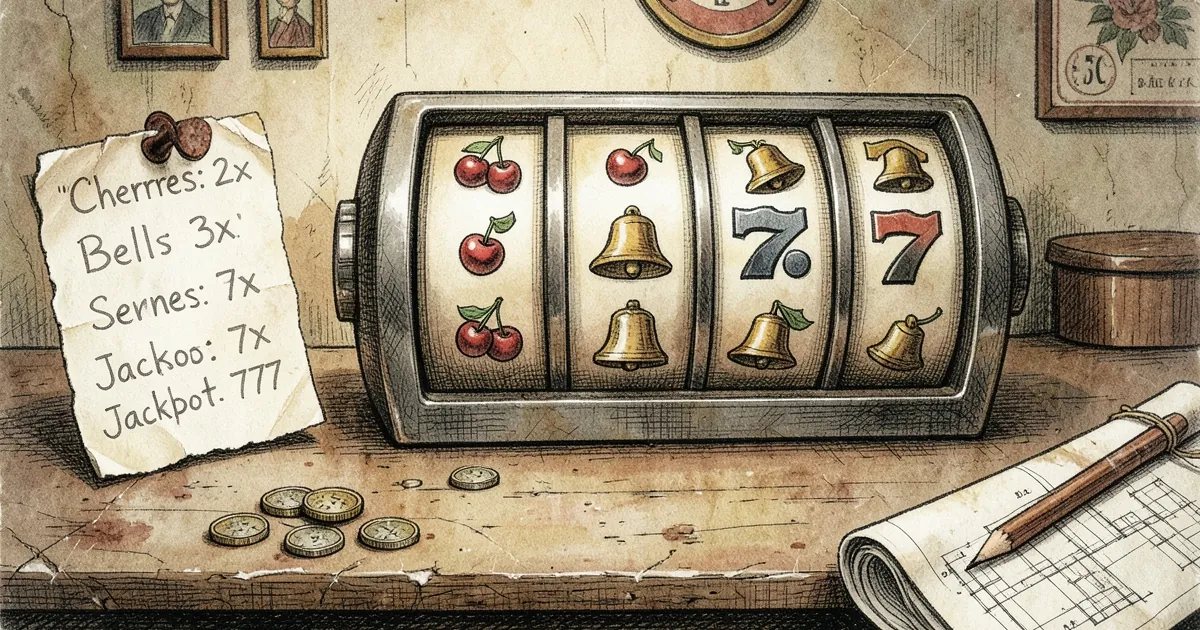
A slot machine's paytable is a menu, not a contract. The symbols and prize values printed on the glass or shown in the help screen describe what you win if the reels land a given combination — they say nothing about how often that combination is scheduled to land. Kevin A. Harrigan's 2007 study in the Journal of Gambling Issues made the gap concrete: a sample three-reel machine carried a true payback of 85.6% at one or two coins and 92.5% at three, while its physical reels and visible symbols implied somewhere between 192% and 486%. The odds live in the software, and the paytable only tells you half the story.
What the reels actually determine
On a mechanical three-reel machine with 22 stops per reel, the payline offered 10,648 possible combinations (22 × 22 × 22) — the figure held until the mid-1980s, when virtual reels began replacing physical ones. The arithmetic is trivial; the consequence is not. Each symbol's frequency on each reel sets the probability of every outcome, and the paytable then prices those outcomes. Change either side and the return moves.
Modern video slots broke the visible link between reel strips and outcome frequency. A game may show five reels with a handful of each symbol, while the underlying virtual reels carry dozens of stops per position. What you see is an animation of a result that was already determined by a random number generator. This is why counting symbols — a genuinely useful skill on 1970s machines — tells you almost nothing today.
The design documents behind those virtual reels are called PAR Sheets, and they are not public by default. Harrigan and Dixon obtained them for games running in Ontario, Canada, through a freedom-of-information request, which is how researchers know how far the visible strip can drift from the programmed one.
RTP is an average, and a thin one
Return to player is the long-run share of stakes returned as winnings, calculated over the full cycle of outcomes. Three things follow, and players routinely miss all three.
It is not a session number. A 96% game does not return 96 zł of every 100 zł you sit down with. It returns roughly 96% of everything wagered across millions of spins. A single session can return 300% or zero.
It is not fixed across configurations. Harrigan's machine paid 85.6% at one or two coins and 92.5% at three — a 6.9-point swing driven purely by bet size, because the top prize required the maximum coin. Many modern games do something similar with bet-level-dependent features, and the difference is disclosed in the rules, not the advertising.
It is not a quality ranking. Two games at 96% can behave nothing alike over 200 spins, because variance does the work at that horizon. That distinction — volatility mattering more than headline RTP once sessions run past 200 spins — is the one that actually affects your bankroll.
Poland sets a floor rather than a target: the Gambling Act (Ustawa o grach hazardowych) requires the programmed payout value on slot machines to be no lower than 75% of stakes paid. That is a legal minimum, not a market norm — most licensed games sit far above it — but it explains why "compliant" and "generous" are different claims.
Why the paytable hides the number that matters
Paytables are marketing documents with a regulatory function. They must list prize values and any conditions attached, and in most licensed jurisdictions they must not misrepresent the game. They are not required to lead with the return percentage, and they are not required to explain how rarely the top symbol appears on reel five.
Harrigan's 192%–486% figure is the clearest illustration of what that omission costs. A player reading the glass could reasonably compute a return several times higher than the machine's true 85.6%, because the visible symbol frequency was not the operative one. The misleading part was not a lie — every prize listed was real — but the absence of the denominator.
There is a second layer. A study in the UNLV Gaming Research & Review Journal put 10,000 virtual players in front of two machines, one with a 3% house edge and one with 12%, and found that an overwhelming majority could not tell them apart. Players do not reliably perceive the difference between a good and a bad game, which means the paytable's silence is not corrected by experience.
And a third: Dixon and colleagues, writing in Addiction in 2010, documented "losses disguised as wins" on multi-line video slots — spins that return less than the stake but trigger celebratory sound and animation. The paytable lists the line prizes; it does not tell you that a 40% return on a 1 zł spin will be presented as a win.
The numbers move, and audits disagree
Even a published RTP is a point estimate rather than a constant. Fund a progressive jackpot from stakes and the base-game return falls — measurably, in the region of 0.8 percentage points while the pool is being filled. Run the same game through three independent audits and you can get three different numbers for the same title, because methodology, sample size and version all shift the result. The 96% on the splash screen is a rounded, version-specific, configuration-specific figure.
For Polish readers in particular, the headline percentage has acquired a weight it cannot carry: a game advertised at 96% is treated as a 96% proposition, when the honest reading is "96% over an unspecified cycle, at a specified bet level, before any jackpot contribution." That gap is what the 96% figure tends to conceal in practice.
None of this makes slots dishonest. The outcomes are random, the return is auditable, and licensed operators publish what regulators require them to publish. It does mean the paytable answers a narrower question than most players are asking. It tells you what each combination pays. It does not tell you how often the combination arrives, how the return changes with your stake, or whether the machine in front of you is the 3% version or the 12% one.
The open question is whether disclosure will ever catch up to design. Regulators in several markets have pushed for mandatory RTP display and, in some cases, for the return to be shown on the machine itself rather than buried in a help menu. Poland's 75% floor is a start, but a floor is not information. If a player cannot distinguish a 3% house edge from a 12% one across 10,000 trials, the useful disclosure is not a single percentage — it is the distribution behind it. Until that arrives, treat the paytable as a price list for outcomes you cannot count, and set your limits on what you can afford to lose rather than on what the glass implies you will win.