September 2026
Empty Platforms, Full Schedules: Poland's Rail Timetable Gap
Poland's rail timetable runs empty trains at noon and packed ones at dawn, revealing how service planning misses real commuter demand
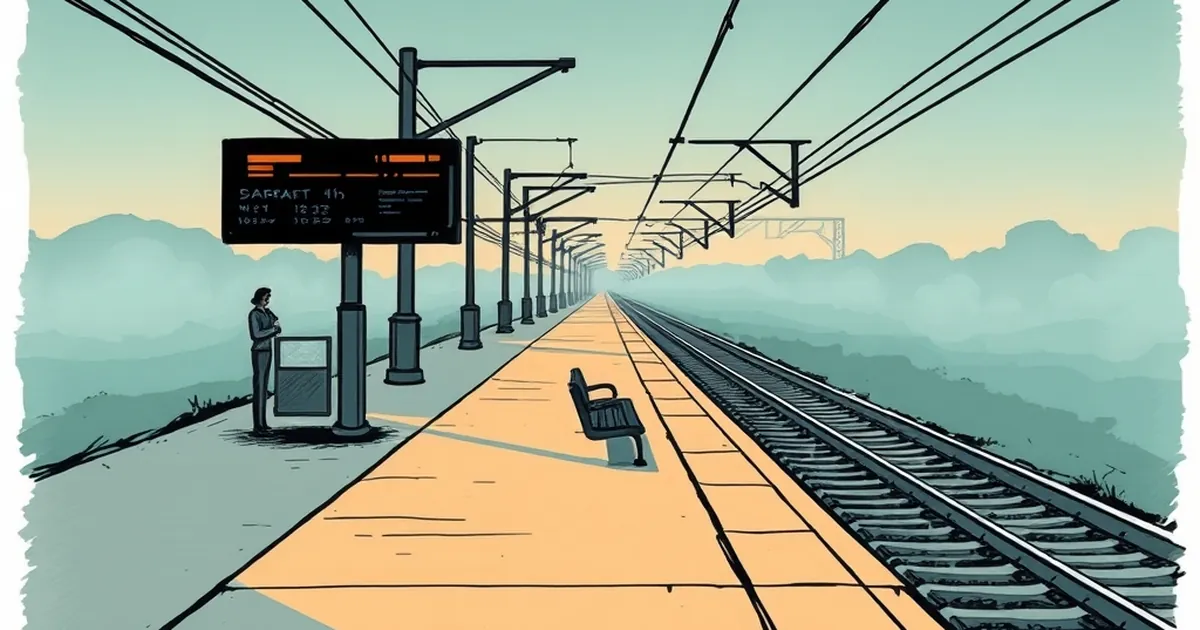
Stand on the platform at Warszawa Gdańska on a Tuesday at 11:40 and you will see it: a departure board listing three trains in the next hour, and roughly nine people waiting for them. Meanwhile, the 7:15 to Piaseczno was standing room only. Poland's rail timetable is not short of services — it is short of services at the hours when people actually need them. So why does a country that has spent billions on new tracks still run empty trains at noon and crowded ones at dawn?
The Shape of the Problem
Polish rail planning works around a simple, stubborn assumption: demand is roughly flat across the working day, with a modest bump at the peaks. Reality looks nothing like that curve. On most regional routes, the morning window between 6:00 and 8:30 carries a disproportionate share of all daily passengers, and the late afternoon between 15:30 and 18:00 carries another. Everything in between — the long, quiet stretch from 9:00 to 14:00 — accounts for a fraction of ridership but a substantial share of train-kilometres.
The result is a timetable that looks generous on paper. Open the Koleje Mazowieckie or Polregio schedule for a mid-sized town like Siedlce or Leszno, and you will find departures every 40 to 60 minutes throughout the day. That frequency is genuinely useful for people with flexible schedules and for students. It is close to useless for the commuter who needs to be at a desk in Warsaw by 8:00 and cannot get a seat on the only service that will do it.
Why the Peak Gets Squeezed
Adding capacity at peak hours is expensive, and not just in the obvious way. Rolling stock is the binding constraint. A train that runs a single 90-minute peak round trip sits idle for the rest of the day unless it is cycled into off-peak work — which is exactly how you end up with a 12:30 departure carrying 14 passengers. Operators rarely have spare electric multiple units sitting in a depot; what they have is a fleet that must be used continuously to justify its own existence.
Infrastructure adds a second constraint. Peak paths through nodes like Warszawa Wschodnia, Poznań Główny, or the Wrocław junction are already close to saturation. You cannot simply insert another 7:20 service without displacing something else. So planners do the rational thing given the tools they have: they spread services across the day to keep the fleet moving and the paths filled.
What the Data Actually Shows
Polish operators publish remarkably little route-level load data, but the patterns are visible in the numbers that do surface. Polregio's own reporting has repeatedly shown load factors well below 40% on many regional services outside peak windows, against figures approaching or exceeding 100% — standing passengers included — on key commuter runs.
The Agglomeration Exception
It would be unfair to paint the whole country with one brush. The Warszawa–Grodzisk Mazowiecki and Warszawa–Otwock corridors, the Tricity SKM, and the Kraków agglomeration have genuinely moved toward all-day, turn-up-and-go frequencies, and ridership has followed. The SKM Tricity runs a clock-face timetable that makes the car genuinely optional for many trips. That is the model that works — but it works because the density is there to support it.
The Regional Reality
Outside those agglomerations, the calculus changes. A line like Kutno–Sierpc or Lublin–Stalowa Wola can support a solid peak service and a thin off-peak one, and no amount of timetable cleverness will conjure passengers who are not there. The honest question is not "how do we fill the 11:00 train?" but "should the 11:00 train exist at all, and if not, what replaces it?"
The Vanishing Connection Problem
Here is a concrete example that captures the whole issue. A reader wrote to me about a trip from Płock to Radom — a journey that ought to be a straightforward regional connection. The itinerary required a change at Kutno, and the connection window was eleven minutes. The first train arrived four minutes late. The second train had already been given the road. The next service on that line was two hours and ten minutes later, at 13:47, and arrived in Radom after 17:00. The whole trip, roughly 200 kilometres as the crow flies, consumed an entire working day.
This is what a timetable gap feels like from the passenger's seat. It is not that there are no trains. It is that the trains that exist do not connect to each other in a way that respects how people actually travel. Guaranteed connections, minimum transfer buffers, and coordinated scheduling across voivodeship borders remain the exception rather than the rule, because each regional operator plans its own network in isolation.
Why Coordination Is So Hard
Regional contracts are awarded and funded per voivodeship. Koleje Mazowieckie answers to the Mazovian marshall's office; Polregio answers to several at once. There is no single body with the authority — or the budget — to impose a nationally coherent timetable, and the incentives point the other way. Each operator is judged on its own punctuality and its own ridership, not on whether a passenger from Płock can reach Radom before lunch.
What Would Actually Close the Gap
Three changes would move the needle more than any new rolling stock order.
First, publish load data. Operators know which trains are full and which are empty. Making that data public — even at the level of a monthly load factor per service — would let passengers, journalists, and local governments argue about the timetable with facts instead of impressions.
Second, redesign the off-peak around connections rather than frequency. A train every two hours that reliably connects to the trunk line is worth more than a train every hour that misses everything. This is the Swiss model, and it is not magic — it is scheduling discipline.
Third, treat the peak as the product. If the 7:15 is the train that pays for the network, it should get the longest platforms, the doubled sets, and the priority paths. Running six-car trains at noon and three-car trains at 7:15 is a choice, and it is the wrong one.
The next time you find yourself alone in a carriage at 11:30, look at the departure board. Somewhere on it is a train that was full this morning. The gap between those two facts is the whole story of Polish rail planning — and it is a gap that better scheduling, not more concrete, can close.