November 2026
Two-thirds of drivers can't recall the last sign they passed
Two-thirds of drivers cannot recall the last road sign they passed, revealing a quiet gap between what we see and what our memory actually keeps
5 min read
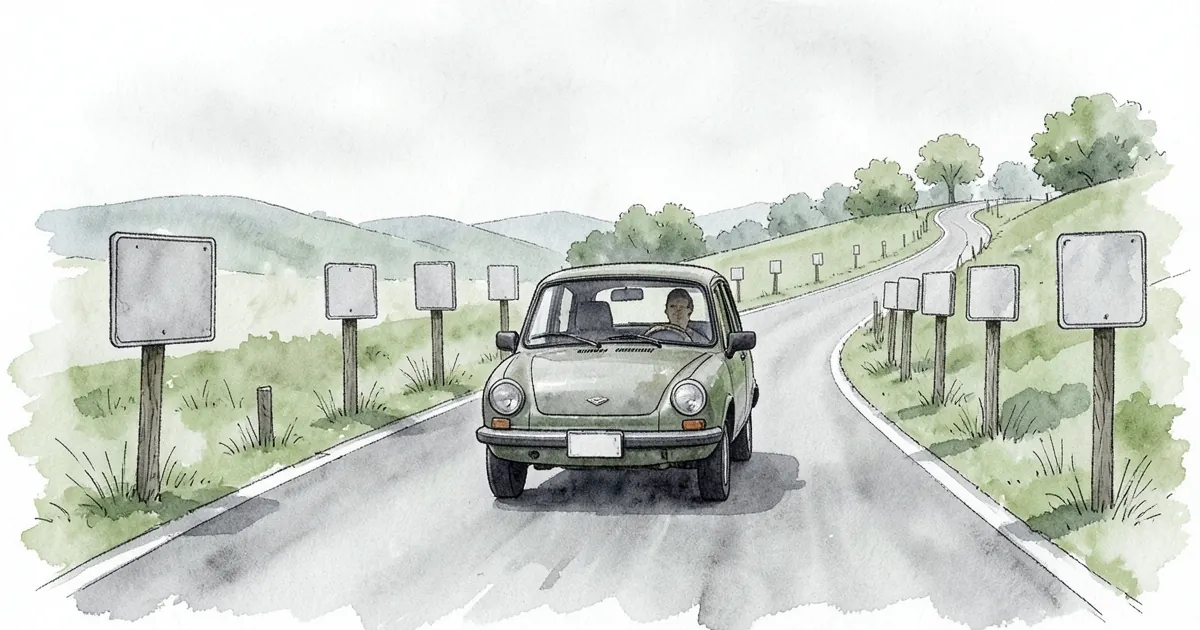
The question is not whether drivers see the sign. It is whether the sign survived the trip from the retina to memory. When researchers ask people to recall the last road sign they passed, roughly two-thirds cannot do it — not the speed limit, not the warning triangle, not the blue rectangle telling them which lane goes where. That gap between exposure and retention is where infrastructure design, behavioral psychology and road safety quietly collide.
The sign is a stimulus, not an instruction
A road sign is a piece of public infrastructure that does nothing on its own. It emits information and waits for a human to process it, and the processing is where the system leaks. Drivers operate in what psychologists call a low-attention state: the task is over-learned, the route is familiar, and the brain allocates just enough resources to keep the car between the lines. Signs that arrive on a predictable schedule get filtered out as noise.
This is not a character flaw. It is how attention budgets work. A driver approaching a junction is already juggling lane position, following distance, mirror checks and a podcast. The sign competes for the same limited pool. When the load rises, the sign is the first thing dropped, because it is the only element that does not punish you immediately for ignoring it.
The same pattern shows up elsewhere in the built environment. Two-thirds of lift users press the button that does nothing, a small daily demonstration that people act on infrastructure cues even when the cue has no effect. The button press is not stupidity; it is a low-cost ritual that feels like control. Road signs occupy a similar psychological slot: we believe we are reading them because we are looking at them.
What two-thirds actually means
The recall figure is usually measured with a simple prompt: name the last sign you passed. Most people cannot. A smaller share can name a sign type but not its content — "a speed limit sign, I think 50" when it was 40. A minority recall accurately.
There is a useful comparison in braking research. When drivers are asked to estimate their own braking distance, about two-thirds get it wrong, and the error runs in a consistent direction: they think they stop sooner than they do. The miscalibration is not random. It is systematic overconfidence in a skill performed thousands of times without feedback. Sign recall fails the same way. Drivers are confident they noticed the sign because they were looking forward, and looking forward feels like noticing. The gap between estimated and actual braking distance is the same gap, measured in metres instead of memory.
What makes this more than trivia is that the failure is invisible to the person failing. A driver who missed a sign does not experience a moment of absence. They experience nothing at all, which is why self-report surveys about sign awareness are close to worthless.
Reward, risk and the 0.3-second tax
The psychology gets sharper when a reward is in the frame. In simulator work, drivers who pass a sign or stimulus associated with a reward brake about 0.3 seconds later than drivers in a neutral condition. Three-tenths of a second at 50 km/h is roughly four metres — enough to turn a near miss into a collision.
This is a textbook variable-ratio effect. When a cue sometimes pays off, the behaviour attached to it strengthens and becomes resistant to extinction. Roadside advertising, fuel-price boards, delivery-app notifications and navigation prompts all borrow the same machinery. The sign that matters for safety is competing with signs engineered to capture attention, and the engineered ones are better at it.
Loss aversion adds a second layer. Drivers slow for a speed camera because the penalty is concrete, immediate and priced. They do not slow for a faded warning triangle because the cost of ignoring it is probabilistic and invisible. Kahneman and Tversky's central finding — that losses loom larger than equivalent gains — predicts exactly this asymmetry. Enforcement is a loss; caution is a gain. Guess which one changes behaviour.
Risk-taking in traffic is also social. Drivers take smaller gaps at roundabouts when a queue is watching, shaving about 0.4 seconds off accepted gap times, because an audience changes the calculus of what counts as acceptable. The effect of an observing queue on gap acceptance is a reminder that sign compliance is not a solo cognitive act. It is a performance, and the audience is other drivers.
Designing for the driver who isn't reading
If two-thirds of drivers cannot recall the last sign, the design response is not more signs. It is fewer, better-placed signs and infrastructure that works without being read.
The strongest lever is positive guidance: the road geometry itself tells you what to do. A curve that tightens visibly, a lane that narrows through kerb alignment, a raised crossing that forces a speed reduction physically rather than legally. These work on drivers who never processed a word. The Netherlands has pushed this logic for decades under the "shared space" and "self-explaining roads" banners, and the underlying principle is simple: if the sign is the only thing keeping the system safe, the system is not safe.
The second lever is salience through contrast. Signs get noticed when they break a pattern, not when they repeat one. A corridor with twelve identical warning plates trains drivers to stop seeing warning plates. A single, well-sited, high-contrast intervention at the point of actual risk does more than a kilometre of signage.
The third is feedback. Drivers miscalibrate because they never learn. Average-speed enforcement systems, which measure speed over a stretch rather than at a point, change behaviour because they remove the brake-then-accelerate game. Poland's system of odcinkowy pomiar prędkości is a working example of infrastructure that closes the feedback loop instead of relying on recall.
What to watch next
The interesting frontier is not signage but instrumentation. Vehicles are becoming sensors, and the data they generate can tell road authorities which signs are being read and which are being filtered out. Eye-tracking fleets, already used in commercial vehicle trials, can map exactly where drivers look on a given corridor — and where they don't.
The forward-looking question for anyone who builds or maintains roads is whether they can measure attention the way they measure traffic volume. Until they can, the two-thirds figure will keep showing up in surveys, and the signs will keep going past unread. The practical move for now is to assume the driver did not read the sign, and design the road so that it doesn't matter.