September 2026
Why Poland's Concrete Roads Crack Earlier Than Asphalt
Poland's concrete expressways should outlast asphalt on paper, yet transverse cracks and corner breaks appear early. Here's what road engineers say
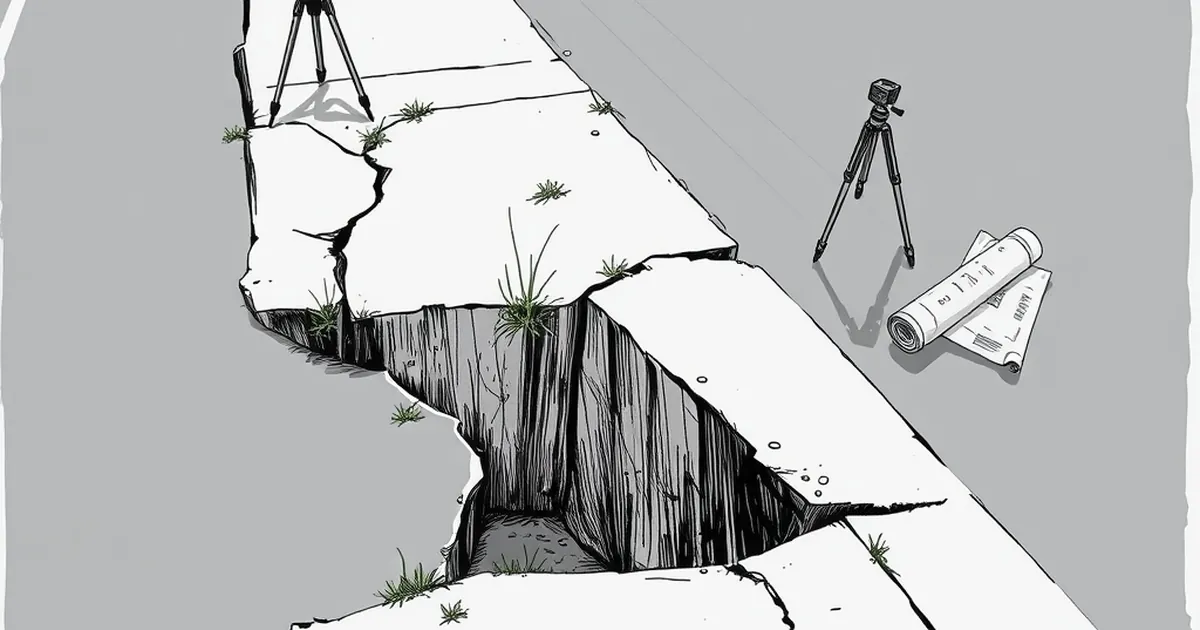
Drive along the S8 expressway near Piotrków Trybunalski, or the A4 between Kraków and Katowice, and you'll notice something that puzzles foreign truckers: vast stretches of grey concrete slabs sitting beside black asphalt, often in the same corridor. Ask a Polish road engineer which surface lasts longer and you'll get a shrug — because the honest answer is that on paper, concrete should win. In practice, in Poland, it frequently doesn't.
The question isn't whether concrete is theoretically more durable. It's why, on Polish soil, rigid pavements seem to develop transverse cracks, corner breaks, and joint deterioration years before their asphalt neighbours are due for anything more than a surface refresh. The answer sits at the intersection of climate, subgrade geology, construction culture, and how we actually maintain what we build.
The Theory Says Concrete Should Outlast Asphalt — So What Went Wrong?
On paper, the case for concrete is strong. A well-built rigid pavement can carry heavy axle loads for 30 years or more with minimal structural intervention. It doesn't rut in summer heat the way asphalt does. It resists deformation under the 40-tonne trucks that dominate Polish freight corridors.
Asphalt, by contrast, is a viscoelastic material. It softens in heat, stiffens and becomes brittle in frost, and its fatigue life is finite. Under identical traffic, a flexible pavement typically needs a structural overlay long before a rigid one needs reconstruction.
So when concrete cracks early in Poland, we're not observing a materials failure in the abstract. We're observing a failure of specific local conditions — and there are several, stacked on top of each other.
The Subgrade Problem Nobody Talks About Enough
Poland's geology is not kind to rigid pavements. Large parts of the country sit on glacial tills, clays, and peats left behind by the Scandinavian ice sheet. These soils are frost-susceptible and prone to differential settlement when moisture migrates.
Concrete is rigid by design. That rigidity is an asset when the foundation is uniform — and a liability when it isn't. A flexible asphalt pavement can absorb minor settlement through deformation. A concrete slab cannot. It transfers stress directly to the subgrade, and when that subgrade moves unevenly, the slab cracks.
Many Polish motorway sections were built on subgrades that were improved, but not improved uniformly. Variable ground conditions along a single kilometre — clay here, sand there, old drainage channels underneath — create exactly the differential movement that rigid pavements hate.
Frost, Salt, and the Polish Winter Cycle
Poland sits in a transitional climate zone. We get hard frosts, but also repeated freeze-thaw cycles within a single winter, sometimes dozens of them. That's more damaging than a consistently cold climate like Scandinavia's, where the ground stays frozen for months.
Water enters concrete joints and microcracks. It freezes, expands by roughly 9%, and pries the crack wider. Then it thaws, refreezes, and does it again. Add de-icing salt — which Poland uses heavily on motorways — and you accelerate both freeze-thaw damage and chloride-induced corrosion of any steel reinforcement or dowel bars.
Asphalt suffers from this too, of course. But asphalt is somewhat self-healing under traffic and temperature: it can flex, and small cracks can be sealed before they propagate. Concrete has no such recovery mechanism. A crack in a concrete slab is permanent and progressive.
Construction Practice and the Curse of the Early Polish Motorway Boom
Here's where it gets uncomfortable. A significant share of Poland's concrete motorway network was built during an extraordinary construction push between roughly 2008 and 2015, largely funded by EU cohesion money and delivered under intense time pressure.
Speed Versus Curing Time
Concrete needs time. It needs proper curing — moisture retention, controlled temperature, and patience. Rushing curing to hit a deadline compromises the concrete's early-age strength development and its long-term durability.
When dozens of motorway contracts are running simultaneously and penalties for delay are steep, curing regimes get compressed. The consequences don't show up in the acceptance tests. They show up five to eight years later, as early cracking.
Joint Spacing and Dowel Bar Details
Rigid pavements rely on carefully engineered joints: transverse contraction joints to control where cracking occurs, longitudinal joints, and dowel bars to transfer load across those joints. Get the spacing wrong, or place dowels with insufficient alignment tolerance, and you get exactly the failure modes we see — corner breaks, spalling, and faulting at joints.
Poland adopted a mix of technologies from different European and American traditions during the boom years, and not all of them were perfectly adapted to Polish ground conditions and traffic loads. Some sections used joint spacing that works fine in milder climates but performs poorly under Polish freeze-thaw cycling.
A Concrete Example From the A2
Consider a stretch of the A2 motorway west of Poznań. Within seven years of opening, engineers documented transverse cracking at intervals far shorter than the designed joint spacing — meaning the concrete cracked where it wanted to, not where the designers intended. The cause was a combination of subgrade moisture variation and thermal movement that the joint layout didn't accommodate. The fix involved full-depth patching of individual slabs, an expensive and disruptive operation that asphalt rarely demands so early.
Why Asphalt Quietly Wins the Maintenance Battle
Even when concrete holds up structurally, it loses on maintenance economics in the Polish context. Asphalt damage is usually progressive and repairable in layers. You mill off the top, lay a new wearing course, and you're done in a night. Traffic disruption is minimal.
Concrete repair is a different animal. A cracked slab often needs full-depth replacement. You demolish it, rebuild the subbase if necessary, pour new concrete, and wait for it to cure. That's days or weeks of lane closure, not hours.
Poland's road maintenance budget is stretched. When a concrete section starts deteriorating, the temptation is to defer intervention. Deferred maintenance on rigid pavements is far more punishing than on flexible ones, because small defects — a spalled joint, a loose dowel — rapidly cascade into structural failures.
There's also a skills question. Poland has a deep bench of asphalt paving contractors and a mature supply chain. Specialist concrete pavement repair expertise is thinner on the ground. Finding a crew that can properly dowel a joint or execute a durable full-depth repair is harder than finding one that can mill and overlay.
What This Means for the Next Generation of Polish Roads
None of this means concrete is a bad choice for Poland. It means concrete demands more from the conditions around it: a stable, well-drained subgrade; a climate-appropriate joint design; disciplined curing; and a maintenance regime that treats joints as critical infrastructure rather than cosmetic details.
The GDDKiA has been moving in this direction. Newer concrete sections specify tighter subgrade uniformity requirements, more rigorous curing protocols, and joint designs adapted to local frost depth and thermal range. Some recent rigid pavement tenders include longer warranty periods, which forces contractors to internalise the cost of early failure rather than walk away after handover.
Watch the sections built after 2018. If the lessons have been learned — better ground improvement, slower construction, and a genuine maintenance commitment — those slabs should still be intact in 2045. If they crack early too, then the problem was never concrete versus asphalt. It was whether we were willing to build rigid pavements the way they actually need to be built.